Category Archives: Literature

I’m writing literature

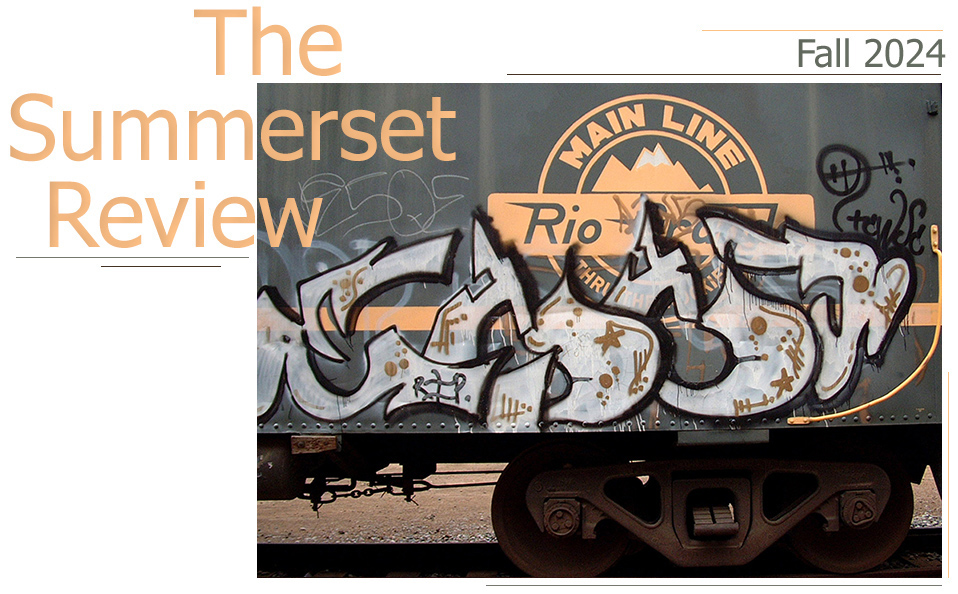
The Summerset Review – “Souvenirs”

I’ve only recently resumed submitting stories for publication, and I am as proud as can be that my short story, “Souvenirs,” has been published in the Fall 2024 Issue of The Summerset Review. The story is about a cab ride not dissimilar to one I took nearly a decade ago, and I was struck by the story the cab driver told me. I spent years considering how I might tell the story, and this was what I came up with.

From the Summerset Review homepage:

The Summerset Review is a literary journal released quarterly on the 15th of March, June, September, and December on the Internet, and periodically in print form. Founded in 2002, the journal is exclusively devoted to the review and publication of unsolicited fiction, nonfiction, and poetry.

Staff Bios

Joseph Levens has had fiction and nonfiction appear in The Gettysburg Review, Florida Review (Editors’ Award for Fiction), New Orleans Review, AGNI, Sou’wester, Meridian, Other Voices, The Literary Review, Zone 3, The Good Men Project, and many other places. He lives on Long Island and currently teaches Creative Writing at Stony Brook University. www.josephlevens.com

Erin Murphy is the author or editor of eleven books, including Human Resources (forthcoming from Salmon Poetry of Ireland) and Assisted Living (Brick Road Poetry Prize, 2018), a collection of demi-sonnets, a form she devised. Her most recent co-edited anthology, Bodies of Truth: Personal Narratives on Illness, Disability, and Medicine (University of Nebraska Press, 2019), won the Foreword INDIES Gold Medal Book of the Year Award. Her awards include the Dorothy Sargent Rosenberg Poetry Prize, the Foley Poetry Award, the National Writers’ Union Poetry Award judged by Donald Hall, a Best of the Net award judged by Patricia Smith, and The Normal School Poetry Prize judged by Nick Flynn. She is Professor of English and Creative Writing at Penn State Altoona. www.erin-murphy.com

History of the Journal

The Summerset Review started as an online literary quarterly in 2002, publishing exclusively fiction and nonfiction. With a staff of three volunteers, the magazine faithfully produced its issues on time, reviewing unsolicited submissions year-round, the great majority of which were made electronically and sent through email from hopeful writers ranging from high school students to authors with many published books to their names.

Since 2002, the journal has taken on poetry, book reviews and art essays on occasion, and produced a few print issues collecting a sampling of work that previously appeared online. Remaining ad-free and accessible at zero cost to readers, the publication has released all quarterly issues on time over its twenty-year history. Editorial staff members are proud to say that they respond to all submissions within four months, do not solicit authors, and do not navigate a slush pile.

The Summerset Review has read at The New York Public Library, national conferences, colleges, and other places, including events sponsored by the Council of Literary Magazines and Presses (CLMP), the New York State Council on the Arts (NYSCA), the National Endowment for the Arts (NEA), the National Council of Teachers of English (NCTE), and the Association of Literary Scholars and Critics (ALSC). Print issues of the magazine are frequently donated to book fairs across the country, with all proceeds going to charitable causes in the respective areas.

Work originally published in The Summerset Review has been reprinted in the Pushcart Prize, the Best American series, the PEN America Award series, the Best of the Net anthology, notable collections such as the Iowa Short Fiction Award, and a great many books published by our contributors.

Mission Statement

We think of ourselves as simply people who like to read good contemporary literature, who want to share the best of our experiences with others. The highest form of retribution for our efforts is a lasting impact on a few sensitive readers of our journal—people we don’t know, people we will never meet. We received an email from a reader once, who said a story in our current issue (at the time) changed her life. Assuming this change was for the better, what more could we ask for?

Leave a comment

Filed under Literature, Memoir, Short Story

‎September ‎29, ‎2021 – Meditation on Joseph Campbell’s Essays

I’ve been reading Joseph Campbell’s writing on myth and on ritual. He has a specific view of the role of religion, myth, and ritual in the lives and beliefs of contemporary civilization, and points to science as the source of a contemporary crisis, in that science has dispelled literalist interpretations of biblical legend (and other religious narrative):

“And in this there is serious danger. For not only has it always been the way of multitudes to interpret their own symbols literally, but such literally read symbolic forms have always been – and still are, in fact – the supports of their civilizations, the supports of their moral orders, their cohesion, vitality, and creative powers. With the loss of them there follows uncertainty, and with uncertainty, disequilibrium, since life, as both Nietzsche and Ibsen knew, requires life-supporting illusions; and where these have been dispelled, there is nothing secure to hold on to, no moral law, nothing firm.”

I can see that crisis as it plays out in the US (and perhaps all Judeo-Christian traditions). Literalism tends to coincide with fundamentalism, because to continue to understand the Bible, and biblical texts, in a literalist sense, one must diverge from a fact-based, “scientific” understanding of humanity and of history all the more rigorously. This not only polarizes humanity, but it further activates the isolationist notions of supremacy that are born of literalist understandings of religious texts: “Now the peoples of all the great civilizations everywhere have been prone to interpret their own symbolic figures literally, and so to regard themselves as favored in a special way, in direct contact with the absolute.”

Furthermore, Campbell sees a crisis in those who lack faith. He possesses a more traditional view of society and culture, and saw the counterculture springing up around him during the sixties as an example of the loss of foundational belief systems. He was also critical of the new age (my term) tendency to adopt piecemeal bits of eastern religions and philosophies divorced from their cultural context:

“With our old mythologically founded taboos unsettled by our own modern sciences, there is everywhere in the civilized world a rapidly rising incidence of vice and crime, mental disorders, suicides and dope addictions, shattered homes, impudent children, violence, murder, and despair.”

Though I’m not certain if these ailments of mankind didn’t exist with equally alarming regularity before the contemporary moment, and though I don’t qualify each of them as a societal loss, I do generally agree with Campbell that today’s secular world is marked by a sense of despair and helplessness. I also agree that this helplessness is in part rooted in the loss of faith-based belief systems that have traditionally provided a recipe and justification for decency and kindness (at least within one’s own community). They have also provided a meaning or a justification for such behaviors, in that human decency and just participation within a given social order may be rewarded in a religious sense. This reward or promise, in its basest form, is a pleasurable existence in some heavenly afterlife. In more heady interpretations of religion, redemption comes in the form of transcendence.

So that is the current predicament: between “the cries of preachers for repentance, conversion, and return to the old religion,” and their challenges to “the modern educator with respect to his own faith and ultimate loyalty,” and, on the other hand, the perceived nihilism of the secular world, themselves suffering from the loss of guiding principles.

And this is where, at least in Campbell’s earlier lectures, he loses focus on the potentiality for a new guiding myth. He limply suggests that it may be found in psychology, with its exploration of the unknown that resides within each of us. If psychology were to investigate the history of myth and ritual, identify the causes and sources of human faith in these systems, and relate that to unconscious needs or desires, then perhaps we could reconstitute a mythos of the individual, a mythos that accommodates personal identity (essential, as it turns out, for better or for worse, in Western traditions).

The primary mistake that I see in this reasoning, and this is not to discount Campbell, because his lectures are masterpieces, and I can see the foundation for much of the contemporary understanding of culture and religion embedded in his philosophies. But I don’t believe that he was able enough to identify the mythological systems already functioning in western society, beliefs and rituals that, while they may not have liturgical foundation, are taken as guiding principles, and are also products of our contemporary moment. I also think that this is a result of a common assumption that we make about science, which is that it exists outside of ideology or ideological determinations – that it is objective.

On the other hand, Campbell sees myths as inherently subjective, reflective of the contexts in which they are believed and practiced. He theorized that the foundational function of myth was to explain the unknown, and, in particular, to make sense of death. Furthermore, there was necessity for individuals to participate within a society, which subsequently required shared rules and beliefs. And finally, at a broader level, the natural context, the environment itself, provided the symbolic material for myth. An example that he uses often is ritual sacrifice within primitive farming communities. A specifically agricultural understanding off the cyclically of birth, life, death, and rebirth led these societies to enact ritual sacrifice in something like emulation of these natural processes.

So the formation of myth and ritual are narrative traditions used to explain natural phenomena and to understand humankind’s role within the natural universe. Yet, the arrival of science appears, at first glance, to be in conflict with these traditions. Campbell believes that: “as a result of the continuing open-hearted and open-minded quest of a few brave men for the bounds of boundless truth, there has been a self-consistent continuity of productive growth.” So, early on at least, Campbell believes that scientific investigation has led to a new and essential understanding of the world, but one that diverged from mythological narrative historically believed to be true.

The old texts comfort us with horizons. They tell us that a loving, kind, and just father is out there, looking down upon us, ready to receive us, and ever with our own dear lives on his mind. According to our sciences, on the other hand nobody knows what is out there, or if there is any “out there” at all. All that can be said is that there appears to be a prodigious display of phenomena, which our senses and their instruments translate to our minds according to the nature of our minds.

It seems that myths and religious narratives, especially in a literalist tradition, are believed to be true by the faithful – to the exclusion of all contradictory thought. And that, with the advent of a revolutionized understanding of the world, with advanced instruments of measurement and observation, the ground or base of understanding is more “sophisticated” or at least different from, say, primitive agricultural societies. Thus, we have a newer context in which our own mythologies are generated.

This being the case, and according to Campbell’s logic, if one believes that there might be a contemporary belief system or matrix of narratives that constitute our current mythology, it would have to be born of this new context which has proved older understandings of the world obsolete. All faith-based belief systems, and particularly those which practice literalist interpretations of liturgy, believe in the truth of that which they are faithful to. And in certain ways, absolute belief makes it impossible for the believer to interrogate their own system. We become blind to the faults of those things we accept as fact. Campbell writes: “For the really great and essential fact about the scientific revelation – the most wonderful and most challenging fact – is that science does not and cannot pretend to be “true” in any absolute sense.” Contemporary secularism has created a sort of dichotomy between science and religion, but, despite Campbell’s more nuanced understanding of science, we have come to take “science” as synonymous with fact.

Before proposing that psychology, and psychological understandings of myth, might be a means to salvaging our dying mythos, Campbell writes:

“In moral disequilibrium, we must now ask whether it is not possible to arrive scientifically at such an understanding of the life-supporting nature of myths that, in criticizing their archaic features, we do not misrepresent and disqualify their necessity – throwing out, so to say, the baby (whole generations of babies) with the bath water.”

And what I would argue is that we are still living in a time of ritual and mythology. Those living within the myth are unable to see it as such. It is naturalized in society as “the way” rather than an object of study, and for that reason, we cannot exactly turn to the old myths for guidance. They are already perceived as such, despite that many elements of those myths and rituals are still evident in current practices (dates of the resurrection coinciding with harvests and such).

That said, perhaps we are still living under the sway of a new narrative, something that provides meaning and guidance, is a reflection of our contemporary society and our physical surroundings, and is taken to explain the world in such a way that accounts for available and observable phenomenon.

Campbell describes something like this reflection of contemporary society as explained through mythology, though he focuses in this case on the pervasive effect of Judeo-Christian religion in the Occident. Campbell, in critiquing the new age fad of sampling, piecemeal, bits of eastern religion in order to establish some form of meaning, says that a western emphasis on the individual, a consequence of religious traditions, precludes us from adopting eastern philosophies. He argues that an emphasis on individuality has prompted humans to do great things, but he also sees the limitations of the ideal, and through recourse to eastern religions illustrates that our certainty in the value of individuality is simply a matter of cultural tradition.

Leave a comment

Filed under Blog Posts, Home, Literature, Memoir

September 18, 2021 – Description of the Northern Lights

The first thing to mention, before the beauty of it and the effect of it, is that it felt like a rare privilege, something that most would not get to experience or see.

I first saw it when I was rinsing the mop bucket on the back deck. I’d been told the conditions in which the Northern Lights were most likely to appear – cold, clear nights. It’s obviously been getting colder and colder, but clear nights are surprisingly uncommon. They’re not unheard of, but the skies are most often overcast, and the phenomenon seems to occur above the clouds. So when I noticed that the stars were out, I began inspecting the skies. And sure enough, I spotted the first band of green vapors over the shores to the east of us. The bands are ribbon-like, curving across the sky, sometimes seeming to approach or fall further into the distance. The base is the most visible, vibrant part, meaning that it is illuminated most brightly and that light fades upwards from the horizon. I was surprised by how dynamic the northern lights were, like a ribbon moving in a breeze. They brighten and dim from one second to the next. And then, in the most intense moments, there is also a sort of vertical movement, as the light dances and shifts in strands that stand upright, reminiscent of the way that water shimmers. The spectacle might be similar to a thick mist, constantly shifting while illuminated from behind. That said, such a description doesn’t quite capture the effect, as the vapors seemed almost to be illuminated from within. At one point, I could see the vapors rippling from the horizon and passing directly overhead, swirling like a vortex above the boat and rising infinitely upward.

And the affect of this, which I tried to describe to you over the phone, was a kind of melancholy. There was a lugubriousnss to the movement of the light, a meandering, sort of lumbering march across the sky. The dynamism of movement meant that they could appear or disappear from one second to the next, but, when observed, the movement seemed slow. Coupled with that was the fact that the vapors seemed to slowly evaporate skyward in a constantly rising mist, the vertical light rising towards the heavens and vanishing. The green color was simultaneously vibrant and solemn, and seemed barely willing to announce its existence within the mist. And yet, the grandure and majesty of it gave it an eternal quality, as if those bands of light had been engaged in that march long before we arrived and would continue it long after we go. 

And of course, the context for this was a freezing night over the Alaskan tundra. I know that those lights are visible in other parts of the state, over other landscapes. But there, in the frozen tundra, over the freezing ocean, in a place that was so inhospitable that it nearly remained frontier but for the intrusion of humans digging away at the frozen land (a local man told me that Christian natives had to bury relatives using jackhammers to unearth the permafrost). It was a lonely place, barely inhabitable by humans, animals, and even plant life. And there’s also something sad about the landscape in that it was a sort of reminder of how much humans have intruded into and exploited the natural world, as if nature had been forced to retreat to this most remote locale, looking back with a sort of mournful melancholy. Completing the ambiance is the shriek of the un-greased belt of the shoreside hopper, which emits a sort of melodic whistle when in operation, a sound like a dozen apparitions whistling in harmony. And so the ghostly lights marching across the sky, already haunting in appearance, haunting in context, come to seem like the final departure of nature, forced to retreat skyward, to some other realm as the humans continue to encroach and intercede. And that is the best way I can describe the melancholy affect of the northern lights.

Leave a comment

Filed under Blog Posts, Literature, Memoir

August 23, 2021 – Meditations on the Buck that Visited Us Each Night

Written as a part of an email home while working on a tugboat in the Arctic Circle of Northern Alaska.

We had an adolescent buck that would visit our backyard each night, and we’d taken to feeding the animal. There were other animals that came though as well – skunks and cats and possums and squirrels and birds – so there were a million noises outside the open bedroom window, and each had to be investigated. But we were waiting for the buck. Each of the other animals was of interest, but the buck was the spectacle.

When he arrived, I cut up apples for him in the yard while he watched me, and left them in one of our barren planters. He was a handsome animal, with a perfectly black nose and muzzle. He watched me with his large black eyes while I prepared his food and I imagined I saw something like sadness there: not out of concern for me – my presence or absence – but because he was no longer a master of the wild there. He was a refugee, creeping through the night.

I was amazed that the old neighbors didn’t like the bucks. If one were able to say that the animals ruined the gardening, or were dangerous, or that there was anything threatening about them at all, then I would have accepted it. But they just didn’t like critters. In contrast, the deer were one of my favorite things – majestic and kind of mysterious. They reminded me Joseph Campbell’s writing. Campbell described a prehistoric time, kind of an origin of myth, before humankind took for granted that they were the ruling species on the planet: 

“In those earliest millenniums… men dwelt and moved about in little groups as a minority on this earth. Today we are the great majority, and the enemies that we face are of our own species. Then, on the other hand, the great majority were the beasts, who, furthermore, were the “old-timers” on earth, fixed and certain in their ways, at home here, and many of them extremely dangerous.”

It’s sad, I think, but the bucks are a vestige of that time. They’re kind of vagabonds, in hiding. They’re furtive, not owners of the world that was once theirs entirely, theirs to exist in utter deer-ness. But now they stalked through the night, strangers in an inhospitable world. Perhaps (I hope) our yard provides a tiny little haven for creatures beleaguered by humankind.

Leave a comment

December 14, 2023 · 12:20 pm

October 18, 2018: The Butterfly as Symbol For Resurrection

I haven’t published much lately, but have maintained my writing practice over the past several years. I’ve been journaling, but sometimes my entries devolve into meditations, some of which I think are worthy of sharing. I hope to post more of these meditations over time, and the first one I’ve chosen with the holiday season in mind.

October 20, 2018

Arielle’s parents’ bathroom has a strand of twine crossing from wall to wall, supporting two dozen bright green chrysalis. They were the green of dreams of springtime fields when droughts and dust were a twinkle in the eye of the creator. A kinetic green, each with similar and alien markings, dots of polished gold. There was a fingernail shaped line of these golden dots along the top of each chrysalis. There were also two dots towards the bottom of each, right where the eyes might be. And the chrysalis itself bore the veins and markings, a kind of hieroglyphic representation, of where the wings would be and where the head would be. But inside there was no butterfly.

There was also no caterpillar any longer, because it had sloughed off all of its butterfly identity. Arielle had shown me a video of this process. The caterpillars, themselves beautifully ringed in yellow, white, and black, would choose a moment, a warm instant, and decide that it was time to pupate. They would climb to an elevated space, affix their proboscis to the roof with strands of filament, and then hang for some time before the first change. The caterpillar hung from its tail in a hook form and the first part to split was the back of its head. The body of the creature writhed, and the brilliant green shown from out of the split in the flesh. The body would whip and like that the head was split open revealing the dreamlike verdant underneath.  

And soon the laceration would grow, and more of the green appear, and the black and yellow flesh shed from the head up, so that, by the end of the process, the green and writhing pod had freed itself from the container of flesh, which hung desiccated and weightless from the same filament that now held the chrysalis aloft. And then, with another few wriggles, the skin, head and all, dropped free and fell to the bottom of the tank. And in time, the green and gold begins to fade, the substance of the chrysalis turns transparent as rice paper, and the wings and the thorax become visible through their container. And then the monarch frees itself, an orb of liquid in its thorax which stretches and flexes and pumps life into the beautiful, delicate wings.

In medieval times, the butterfly was seen as a symbol of the resurrection. The caterpillar was the earthbound and begrimed creature. But, in time, its earthly coil was shed, sloughed off and discarded and left behind. And then, from the primordial essence comes the butterfly, a beauty so stunning, so contrary to the worm from which it was formed, that it could seem divine. The wings expand, stiffen, retract, and the animal takes flight. And we, too, strive to become this after abandoning our own tenement of clay. And in this sense, the butterfly is a symbol for our own transcendence, for the way which a body is left but a soul takes flight. The terrestrial is abandoned for the heavenly.

But when the butterfly is the symbol for transcendence, what becomes of identity? Does one’s personhood transcend as well? Does the Butterfly retain anything of the caterpillar? I was reminded of an episode of a radio show, Radiolab, I’d once heard, that discussed the symbology of this metamorphosis. In that episode, “Black Box” (first aired January 16, 2014), their producer, Molly Webster, met with a lepidopterist, in whose lab were thousands of living butterflies of all varieties. The scientist takes a pupa from the ceiling, lays it onto the examination board, and slices open the flesh of the chrysalis. There is nothing of the caterpillar inside. Nor is there any indication that a butterfly might emerge. All that exists is the intermediate plasm of existence, the thing that separates the unformed from the formed.

On one hand, the symbolic ideal is to shed all earthly blight, to rid oneself of the terrible stain of having inhabited a body that ages and desires and swells and cracks. And in regard to the caterpillar and butterfly, there is an intermediary stage, the chrysalid, during which all signs of caterpillar have been erased. If one were to open up the chrysalid, only a paste would emerge. Nothing is left of the original creature.

Carolyn Walker Bynum, in the chapter of her book, Metamorphosis and identity, “Metamorphosis, or Gerald and the Werewolf,” writes:

“In The Resurrection of The Body in Western Christianity, I connected the extreme literalism and materialism of twelfth-century notions of resurrection at the end of time with a fear of metempsvchosis, of loss of self through loss of body, or – to put it another way – with a pervasive conviction, underlying many genres and divergent discourses of the period, that the human person is a psychosomatic unit whose survival necessitates bodily continuity…”

In the twelfth century, theologians and philosophers wondered about the complications of a bodily continuity as it regarded issues of resurrection. Would a baby child be resurrected in the most perfect moment of a hypothetical life? Because what would be the benefit of resurrecting a baby incapable of rational thought or satisfying human agency? On the other hand, if one lived into senility, in what form would that person return? Would there be an ideal-self separate from the body? In this sense, the body that one inhabits is relevant – it is the vessel through which a resurrection will be engendered.

Bynum goes on:

“Orthodox attacks on heretics for metemsychosis – that is, body-hopping, body-exchange, or body-erasure – came, I argued, at the height of Western understanding of resurrection as materialist and literal. Scholastic and monastic discussions of the twelfth and early thirteenth centuries saw an embodied self as locus of identity and connected this identity with triumph over change, over physical process and decay. Bodily resurrection was thus both supernatural and natural. It is natural for the human person to have a body, and survival of soul alone is hence an aberration that cannot be perpetual; but divine power is necessary, for in the natural order biological entities give birth only to like, but numerically separate, individuals (additional instances of the species).”

Because the body is the locus of identity, resurrection presented complications to twelfth and thirteenth century scholars. The soul could not exist independently of the vessel and the vessel at death and after succumbs to putrefaction. Thus, the decay inflicted on the inanimate body indicate the earthly deteriorations, the aging and changing, the impermanence that Christian tradition has had such a pathological horror of. The body cannot be reincarnated in its deathly form.

And yet, without the original body, with the idealized and angelic transformation that the butterfly represents, the body is left behind and a new form is taken. As Bynum notes, the fear of metempsychosis is connected with “a pervasive conviction… that the human person is a psychosomatic unit whose survival necessitates bodily continuity.” Furthermore, “monastic discussions of the twelfth and early thirteenth centuries saw an embodied self as locus of identity…” Hence, the symbol of the butterfly becomes problematic when one takes into consideration the belief that identity will be wholly lost if the body is not retained. If the soul is to animate a new form, the original identity will be lost with the original form.

“Roger Bacon, using conventional arguments that entities give birth only to like but separate instances, not to the same instance, maintains that bodily resurrection (return of the same instance) is possible because God reduces body to prime or first matter and induces the same form in it again.” In this sense, even the body is re-formable from Materia Prima, the material from which all the material is formed. Or, more exactly, material that formed the perfect models for all degraded forms of existence. Hence, the soul would have to inhabit that same body – body is still requisite for continuity of identity – but, as formed from first matter, the body is regenerated in its ideal form, perhaps a form it had never taken before – as in the case of the deceased baby who is reincarnated as a grown human.

So though the butterfly is an inspiring metaphor for the resurrection in our idealized forms, the question persists: what of the original caterpillar is preserved in the butterfly. The two forms are so distinct as to seem incomparable. The second entirely unique, so that the first has been subsumed. This erasure of the body could be seen as an existential threat within an ethos that deified continuity and abhorred degeneration.

In his essay, “How Did Insect Metamorphosis Evolve?” Ferris Jabr discusses early enlightenment understandings of the caterpillar metamorphosis:

“1651 English physician William Harvey published a book in which he proposed that caterpillars and other insect larvas were free-living embryos that abandoned nutrient-poor “imperfect eggs” before they matured. Harvey further argued that the cocoon or chrysalis a caterpillar entered during its pupal stage was a second egg in which the prematurely hatched embryo was born again. He entertained the idea that a caterpillar was one creature and a butterfly was an entirely different beast.”

The valuation of these forms of existence persisted in the seventeenth century, in the musings of scientists whose enlightenment thinking was moving them further and further from recourse to divinity, establishing the ideology of experimentation, observation, proof, and analysis. But the ideological inception of these valuations remained rooted in Christian tradition. The ground-dwelling insect was born of imperfection. The cocoon was a second egg, and the embryo was born again, an elevated animal, one of an entirely different species. What was flawed and terrestrial and undeveloped in the first lifeform became an “entirely different beast” in its second life.

In the chapter of Bynum’s book titled, “Shape and story”, Bynum offers varying definitions of identity:

“Finally, identity can mean spatiotemporal continuity. In this sense, identity refers to the fact that I am the same person I was a moment ago. This third understanding of identity carries the connotation of oneness or integrity… it offers the deepest and rawest threat to our grounding as a self. For considering identity in this sense raises doubts about whether anything perdures – my personality, my cat, my briefcase if I take my eye off it for even a moment. If I have amnesia, does my body guarantee that I am “me” over time? What if it then undergoes a sex-change operation and complete cosmetic surgery? Is there any sense in saying that such an altered entity is “the same individual,” whereas a donor mouse and its clone are two separate individuals?”

The fear is that the butterfly, in its absolute difference from the thing out of which it was formed, will retain nothing of the caterpillar. In the terms of a symbology, the parallel would mean that the self would be completely subsumed in the act of resurrection. But selfhood, personal identity and individuality, had become so much of what we yearned to retain in western traditions. To lose the self in resurrection would not be resurrection at all. The consciousness was embodied in the form and without the form, the self would vanish. In crude terms, who would care if the butterfly left the chrysalis as the most beautiful and angelic form imaginable, it isn’t a desirable inevitability if the caterpillar is not there to enjoy her new existence. What would the promise of resurrection be if the person was lost?

Molly Webster, producer of Radiolab, touches on this exact dilemma. So, she asks, what is maintained from one form to the next? In that podcast, she talks to Marth Weiss, a professor of environmental studies at Georgetown University. Weiss had been able to condition the caterpillars to detest a specific odor by way of negative reinforcement (shocking them). The caterpillars were then allowed to pupate, and Weiss discovered that the moth that emerged would also be adverse to the odor. “My feeling is, Wow. I think it’s amazing that a caterpillar can have an experience, go into its chrysalis, five weeks pass, emerge as a seemingly different organism, and that it still can recall experiences that happened to it when it was a caterpillar.” What this ostensibly meant is that a speck of the brain is preserved. The butterfly retained a spark of the identity the caterpillar passed along, via the intermediary substance of the pupal stage, via some sort of bodily continuity.

When I reconsidered the video that Arielle had shown me, I remembered the markings that remained around the chrysalis once the caterpillar skin had fallen free. I could make out the markings of the caterpillar from which it was it was molded – visible in the subtly yellow rings, the crescent of golden dots. And looking at the chrysalises that hung in Arielle’s bathroom, I could see, etched in the green flesh, features of the butterfly to come, outlines of wings and thorax, the casing dotted with gold like the nodes of a blueprint.

In regards to the English physician William Harvey, Ferris Jabr writes:

“Some of Harvey’s ideas were prescient, but he mostly misinterpreted what he observed. In 1669 Dutch biologist Jan Swammerdam rejected Harvey’s notion of the pupa as an egg and the butterfly as a different animal than the caterpillar. Swammerdam dissected all kinds of insects under a microscope, confirming that the larva, pupa and adult insect were phases in the development of a single individual, not distinct creatures. He showed that one could find immature moth and butterfly body parts inside a larva, even before it spun a cocoon or formed a chrysalis. In some demonstrations, for example, Swammerdam peeled the skin off silkworms—the larval stage of the domesticated silk moth (Bombyx mori)—to reveal the rudimentary wings within.”

The butterfly was always already inside the caterpillar. The architecture had been forming in there all along. Swammerdam had been able to open up the body of the caterpillar, part the flesh, and show that, along the inside walls of the creatures, “one could find immature moth and butterfly body parts inside a larva, even before it spun a cocoon or formed a chrysalis.”

Which mean that the caterpillar was already born with the form its resurrected self as a physical part of its own body. The identity of the creature’s reemergence was formed as a hidden part of its physical structure. In this case, the identity of the caterpillar is not lost. Rather, the identity of the soul in ascendance is established before the animal has ever entered the pupal stage. So that the identity of the soul is developing in the body before the body knows or perhaps despite the body not knowing that it is already incubating the transcendental part of its self. The identity is something that forms around the soul, and perhaps the soul is a means of conveyance for that identity. Regardless, the body is already generating the structure for ascendance, the means of conveyance away from the gross physical world. As Molly Webster asks, “What of my future self is in me now?”

Symbolically, the caterpillar predetermines the structure of its ascendance. But, as Matthew Cobb, professor of zoology, acknowledges in Radiolab, the biological truth of the organism reveals that the process is not at all about death and resurrection. Rather, it is about the continuity of life. That, in itself, when considering notions of afterlife, or of the ascendance of the soul, reintroduces anxieties about identity, because even if the soul retains the identity, it is also not being reborn, but is existing continuously as variations of the earthly form.

The lifespan of the caterpillar is also, perhaps, not a fitting a metaphor for the earthly lifecycle of humanity. We rarely experience the moment of incubation and rebirth. We rarely undertake the departure as one person only to return as another, imbued with the wisdom and insight of one who had “grown wings” so to speak. This metaphor is much more evocative of a growth moment, a sort of sea change, catalyzed by specific events or experiences.

Furthermore, the continuity that we see in the butterfly, the preconceived form determining the post-development, post-transformation form, has its complications for the questions of identity. For, though we find in the body the locus for identity, we also refuse to consider that identity may be out of our control. The sense of selfhood is something shaped and determined, something manipulable and representable – something that we consciously embrace and represent (typically through consumerist choices).

In the contemporary, technological world, this can be seen in the curation of self-hood via electronic forms and social media platforms. A person is no longer an identity limited to the confines of a body, but is now a compendium of the various artifacts that are shared universally, the combination of which is unique to that person alone. The formation of identity, the development of the form that we will inevitably become, is not something that remains a physical and anatomical predetermination, but is a work in progress, as self-curative project that is always a matter of self-selection.

I personally would have feared the notion of a biological determination of the soul, and continue to fear such things. This is not because I want to believe that I am in control of my own identity. Rather, I glory in the mystery that I do not know how I have become. Biological determinism is defeatist and leaves little room for change and growth. If my butterfly precedes me, then what is the point of personal growth when my ascendance has already been written? The same can be said of genetic determinism. If the soul that animates me is a matter of the genes that I’ve inherited, then what of every decision I’ve ever made? Was there any agency at all? What is the purpose of deciding? What is the purpose of struggle and pursuit? Conversely, why try to change and grow and become better as a human among humanity? Because that too would be lost in a deterministic understanding of human identity.

Nevertheless, there is relief in considering that the person I am has some physiological or biological or spiritual foundation that precedes the influence of all cultural signifiers. Arielle and I had been discussing, before ever considering the relevance of butterflies or identity, the Marxian notion of reification, as was later developed by Herbert Marcuse. In the Marxian conception of the term, reification represented the moment when the human becomes something written, something without agency. Counter-intuitively, objects had become the active, agential, generators of meaning. The object is the performer of identity. The consumer, thus unwritten, accepts the identity bestowed by the ownership of things.

Marcuse went further to discuss the ways in which human desires were not actually a matter of personal tastes, but were a product of a market system that peddled in identity. We mistakenly believe that identity is a factual and measurable substance, as determined by the cultural signifiers that one accumulates. The signifiers themselves – the music or art one likes, the political beliefs one has, down to the secret desires one experiences – are all collected from a vast trove of cultural ephemera, and that ephemera is the million billion dust motes of a capitalist system in which identity has become commoditized. If there is a core and unalterable potential self that precedes all of acculturation, then perhaps there is hope that the substance of human identity can be re-centered in physical and experiential activity, rather than hypostatization and consumption.

Bynum, C. W. (2005). Metamorphosis and identity. Zone.

Jabr, Ferris, “How Did Insect Metamorphosis Evolve?” Scientific American, SCIENTIFIC AMERICAN, a Division of Springer Nature America, Inc., Aug 10, 2012. https://www.scientificamerican.com/article/insect-metamorphosis-evolution/

WNYC Studios, RadioLab, “Black Box”, First Aired Jan 17, 2014. https://radiolab.org/podcast/black-box

Marcuse, H. (1987). Eros and civilization. Routledge.

Leave a comment

Filed under Blog Posts, Literature

Aluxes

By Ben Leib

The pueblecito was laid out just as we’d come to expect and rely on. We parked in front of la catedral and approached one of the pastor vendors operating at the perimeter of the plaza. Colin inquired in Spanish if there were any cenotes close by that we could swim in. The vendor answered that there was one nice cenote about six or seven kilometers outside of town, but the roads were very bad and we’d never make it in our rental car. No, if we wanted to see the cenote, it would be necessary to either rent scooters or hire a truck. “Where can we rent a scooter?” Colin asked. The vendor replied that first we must find a person who owned a scooter. Then we’d have to offer money. He was vexed when Colin asked about a truck, and waved us off. “Why don’t you go talk to the police officers over there?” He gestured toward el palacio, which, typical of Yucatecan pueblecitos, was the government building that faced the plaza opposite la catedral.

A dozen officers lounged in the shade of the palacio awning. They smoked cigarettes, looked authoritarian, and spoke little. Perhaps the heat of the day had drained the language out of them, but out in the lawn of the plaza, without any protection from the sun, the antojito vendors conversed spiritedly with their customers.

Colin approached one of the officers and explained that we were passing through town and hoped to swim in the cenote, which we’d heard was quite beautiful. We had been told that maybe the officers knew someone with a truck who could take us, because our car couldn’t make the drive. The officer was short and dark complexioned, nearly indistinguishable from the Mayan population who must have shared heavily in his bloodline. He was a grinning and turned to his partner, who was taller but more tacit. Their discussion was too rapid for me to follow. Then both policemen stepped from the shade of the palacio awning and gestured that we should follow them.

The short officer’s pickup truck was parked beside one of the official police trucks, and was in far worse condition than the official vehicle, though neither was too lovely. The passenger-side handle was broken, and the officer had attached a wire hanger to the inner mechanisms of the door. The two policemen climbed into the cab of the truck and indicated that Colin and I should ride in the bed. I had a bottle of water, a towel, and a few hundred pesos folded into the inner pocket of my board shorts. I wore sandals and a t-shirt ripped at the shoulder: I looked like an asshole.

The road didn’t vanish suddenly. We drove through town and it was as if the paving faded gradually and then crumbled into dirt and rock, narrowing to little more than a hiking trail. Our economy sedan wouldn’t have survived. When I stared into the cab of the truck, the two Mexican policemen were smiling and joking with each other. The shorter man drove, focusing on the topography as he swerved around rocks and craters. I turned to Colin: though we never reached speeds higher than ten kilometers an hour and rarely higher than five, I could have been watching a rodeo. Colin sat flat on the grooved steel bed, his long legs splayed, his arms gripping the walls behind him. He was lurpy and wide-eyed, and I prayed I possessed more composure. I sat atop the wheel well, where I got pummeled by the dust that blew over the cab of the truck and coagulated in my sweat. I could feel a deep burning as the sun beat through layers of skin.

We drove for half an hour and then the truck pulled to a stop facing a bower of fecund trees huddled in a field, marking a fresh water source beneath. Colin and I jumped from the bed of the truck and followed the uniformed men. Between the trees was a hole in the ground, two meters in diameter. We stood around it, looking ten meters into the cenote beneath. A shaft of light shined through the mouth of the cavern, hit the surface of the underground lake at a diagonal, and continued into the turquoise blue. Massive root networks hung beneath the trees: wooden dreadlocks that ended an inch into the water.

Colin and I discussed if we were supposed to jump from the mouth of the cavern – we could survive the ten meter fall – but when he put the question to the officers they laughed and shook their heads. They led us thirty meters, to an open shaft through which we could descend to the lake’s surface. We followed them down the shaft and into the cavern. One of the officers lit up a smoke and warned us of the mosquitos that rested like a film along the water’s surface. The cavern was a perfect dome, but the bell-shaped walls continued their outward slant, so who knew how broad the room grew beneath us? Who knew how deep?

A ledge of rock lined the cavern. The policemen gestured that we could walk along the wall, and if we jumped into the water, we would be able to climb back out at the far end. Colin and I made our way along the ledge. I looked into the abyss. It was black except for where the light shone into it. There it was turquoise, and in the light a breed of black catfish swam like illusory plays of light. They fed on mosquitos, which fed on of the blood of birds and small children who swam in the underground lake. Nothing else lived in the water.

Colin jumped in feet first and I dove behind him. The water was shockingly cool after battling the heat. We swam the breadth of the cavern, exploring the root networks. I waved my hand back and forth across the surface as I swam, clearing the mosquitos out of the way. When my movements were subdued, the catfish would get curious and nip at the dead skin on my legs and feet.

The police leaned against the rock wall and smoked cigarettes. Colin and I swam in the shaft of sunlight and were able to see five meters into the water beneath us. We talked about the drive we’d be making to Koba that afternoon. Our trip was coming to an end after a month of driving. I’d soon be travelling to Halifax and embarking for work from the Scotian shores. I felt as if all my endeavor was an attempt to recreate something nostalgic.

Colin and I made plans for our return to the coast. We would jump into the Caribbean no matter what time we arrived, before even finding a guesthouse. It was imperative.

When we got tired we swam to the platform and climbed out. The rock ledge sat three or four meters above the surface, and I jumped from it many times. I inhaled and dove. I opened my eyes under water and swam down until the light faded to darkness. My heart beat as if the world were disintegrating. Panic set in. I turned toward what I thought was the surface, and saw the shaft of light still visible above me. The sun light no longer illuminated my hand in front of my face, but existed as a solid mass hovering in the space overhead. Even the black catfish remained close to the shaft of sunlight in order to survive. I dove again and again, each time with the consciousness that the abyss continued indefinitely beneath me. I wondered what kraken might emerge from that wormhole.

When the officers got bored they climbed back to the surface. Colin and I swam until we couldn’t tread water anymore. We wanted to make the most of a difficult journey by glorying in our rewards, though the journey itself, in accordance with all clichéd literature on the matter, was more valuable than the destination. Hell, the cenote was just a place between Izamal and Koba, just a place we’d happened upon and we made the most of our good fortune. And when we were too exhausted to swim any longer, we dried ourselves before ascending to ground level.

Looking toward the mouth of the cavern, I saw the officers were speaking to two Mayan men. They wore tattered clothes and each had a bindle slung across his shoulder. The four men stood around that giant hole in the ground, and I imagined they’d been watching us swim. When the shorter of the two officers turned toward us, I saw the rifle in his hands. I looked at Colin, who’d gone pale. “Dude, what the fuck?” he muttered. He was less used to guns, though my heartrate doubled just then, and I didn’t know where the rifle had come from or what to make of it. The officer didn’t have it when we arrived. I could tell it was old and well used. There was little patina on the gun metal, which was well-maintained, but the wooden stock had lost its finish where it’d been touched too often by human hands.

The officer didn’t notice that he’d frightened us. He smiled, turned back towards the mouth of the cenote, leveled the gun skyward, and fired a round. A brief ribbon of smoke coiled from where the hammer had tapped the bullet, something fluttered in the trees, and then a bird fell, flapping all the way down, through the hole and into the water beneath. Colin and I joined the other men looking down into the cavern. We watched the wounded bird struggling at the surface, flapping her wings but unable to turn from her back. The officer smiled at his marksmanship, and I marveled at the smallness of the bird and of the caliber of the bullet: a miniscule creature with an even smaller hole into it. It struggled, not dying, but without a chance of survival. One of the Mayan men took a sling shot from his hip, loaded the cradle, aimed, and fired downward. The water exploded around the bird, and the animal stopped moving. Then the police nodded to the Mayan men, and we turned back toward town.

1 Comment

Filed under Literature, Short Story

Stout of Heart, Bereft of Mind

By Ben Leib

The shadow of the helicopter was visible beneath us, a blurry oval tipped forward and moving over the surface of the New Orleans swamps and waterways. I wasn’t faring well. It had been too long since I slept, and I’d been experiencing the slow passing of time as an undeserved cruelty. Or maybe it was deserved.

I’d signed up for a five week rotation. It wasn’t my first, and I’d been working aboard the Ferdinand for the better part of a year – five weeks on, five weeks off. But the survey was coming to an end, they’d prematurely cancelled our replacements, and the five weeks began to grow. It got longer. First it turned into thirty-nine days. Then the six week mark passed, and then the seventh. We’d been strung along with promises of a return to land that were never fulfilled, and I spent those last three weeks in steady decline.

It was the third of February when the survey came to an end. This happened abruptly. I’d finished my night shift and was bed just after noon. And then I proceeded to lay there, rolling from one side of the bunk to the other, fantasizing about how wonderful it could feel to sleep. There was a viciousness to my insomnia – a voice of paranoia whispering that I was indisputably an asshole, and that the shore-side population had finally figured it out. I knew I’d return to find the world had turned on me and I believed that decision justified.

Then someone pounded on my door. I nearly fell out of bed. “Yeah.”

Drew appeared backlit in my cabin doorway. “They done shooting. We have to retrieve the gear.” The survey was over. My job was nearly done. But I still had work to do and it would take me all day to do it, but that was all right, because what sleep was I getting anyway?

Twelve more hours passed. Drew, Dori, Amy, Rufino and I spent them coiling, spooling, and labeling cables for shipping. We wrapped laptops in metric yards of cling film so that they might stand up to the elements when left in a wooden crate aboard the deck of a supply ship. We drafted our biweekly environmental impact report, and then the end of project report. We redrafted them, and then we submitted everything to the desk jockeys in Houston.

More than twelve hours passed.

We were informed that the party chief had rescheduled the helicopter, and we’d should expect to depart at eight AM. Great news, objectively, but I began wondering if I’d ever sleep again. I took a break from composing and proofreading reports in order to pack my bags, and to launder my work gear.

“They’re going to let you leave,” Alessandra asked.

“And you said that you’d never get off this ship,” Patrick reminded me.

He was joking, but there’d been a point when I imagined dying out there. And eight weeks wasn’t so long, either. Two months without seeing land, without the love of friends and family. But the possibility of that two months stretching on forever hadn’t seemed so remote.

The day the internet went out had been bad.

“We’ve been troubleshooting all day,” Drew said. “It’s not the satellite. It’s not the router…”

“Well, isn’t that fucking convenient.” It was an expression of paranoia. We’d been getting jerked around by shore-side vessel managers and suddenly our only means of communication had been taken from us. I indulged fantasies of a week’s worth of radio silence while those fuckers toyed with my fate. They’d reestablish lines only to inform us that the survey was delayed through the Summer. Then – click – they’d cut the wires again. Maybe the fall. Maybe they wouldn’t let me off the boat for a year.

“What if there’s a fucking apocalypse?” I imagined risen corpses eating the flesh of my captors. “What the fuck would we do then?” I sat in the mess hall drinking coffee with four other guys from the instrument room.

Ike laughed. “At least we’d survive.”

“Would we? Would we fucking survive? We’d keep working this survey, mowing the fucking lawn out here, back and forth, over and over, waiting to hear from the Houston office that we’re all clear to move on. Without word from Houston we’d never leave.”

The guys indulged me with their nervous laughter, but they also eyed me. I told myself to reign it in. That was the beginning of week six.

When Drew approached me the following day to inform me that there’d just been an issue with a power supply, and the whole time the problem had been hiding in plain sight, and the satellite was working again, I still felt my paranoia just.

Rufino had it worse. The guy’d already spent four months on the vessel before they began pushing back the departure date. The administrators were less considerate to the Filipino employees, and it was taken for granted that they possessed something close to super human capabilities – as if they could easily put up with things that crewmembers of other nationalities wouldn’t consider attempting.

“Those guys will stay out here until their visas expire if they’re given the opportunity,” The party chief had told me, echoing the general opinion of the vessel managers who ensured Rufino would see such a fate.

When I asked how he was doing, Rufino responded, “My mind is sand.”

In the time since Rufino had boarded the ship, Typhoon Haiyan hit and Rufino’s Tacloban home had been rendered splinters. His wife survived unharmed and was living with her parents. Their neighbors were all homeless. Then the Bohol Earthquake struck, taking innumerable lives including that of Rufino’s closest friend. That was enough tragedy for one man to endure. It’d all happened back in October. I’d been back home since then, for the month of November.

Then in January, just in order to keep the man on his toes, fate served Rufino up another helping of misfortune. His next door neighbors, devastated by the storm, found themselves facing what they may have experienced as insurmountable destitution. The patriarch murdered his wife, two children, and then took his own life. These were Rufino’s friends.

If I’d been a shade more selfish, I would have resented Rufino’s travails, for his strength served to highlight my weak-mindedness. He suffered more than I did. “I cry at night when I’m alone,” Rufino told me. I tried to keep that in mind.

On Christmas, the galley staff put in overtime and cooked a huge spread for dinner and then again for lunch. A couple of the navigators had organized a raffle and BINGO, and whispers of a delayed crew change had yet to begin.

It wasn’t the first Christmas I’d spent offshore, and the same protocols played out on every ship. Folks walked around the vessel, shaking each other’s hands and wishing each other a happy holiday. It was a performance of the most minimal of acknowledgments that something might have been missed. It was an expression of solidarity, if not exactly celebration. The meal was something to look forward to, and then everyone trudged on, that much more determined to get back to their lives and their families.

I’d spent Easters, Forth of Julys, Thanksgivings, Halloweens… The Christian holidays were the ones that everyone seemed to acknowledge. The uniquely American holidays were totally unknown to the majority of an international crew, and I kept my mouth shut about my own Jewish traditions. Muslims, Hindus, Buddhists, and Taoists were also noticeably silent, though they were represented among the Ferdinand’s sixty-three crewmembers.

New Year’s offshore was different, and surprisingly more traumatic. People managed to be happy on Christmas – happy because it was Christmas. But spending New Year’s on the boat felt like terrible tidings of the three-hundred and sixty-five days to come. Delays had been announced and we were reminded it was our choices that had led us to such a predicament – we couldn’t blame anybody else for where we were.

That evening, the galley staff set out hats and noise makers in the mess hall. As midnight approached, a handful of crewmembers on shift collected this ephemera and migrated to the wheelhouse. It was dark but for the navigation systems – a few lights and monitors. A red glow lent ambience, and I was able to see that twelve of us had congregated there.

I was the only one who counted down to midnight. I screamed the number ten and everyone stared at me. By the time I got to one, it was just a determined whisper, and then I blew my cardboard horn. A few of the other guys blew their horns, too.

I held my arms out and walked toward Amy. She stiffened her arms at her side – a defensive position akin to playing dead – and she averted her face as I approached. “I don’t know what you want.”

“Give me a hug.”

“Okay.”

“Happy New Year’s.” I hugged Amy because she was the human being on the ship with whom I shared my job duties, and because she was my best friend out there. But I also hugged her because she was the only woman out of the dozen of us in the wheelhouse. I felt self-conscious about that fact, and decided that I needed to hug every other crewmember up there lest I be misinterpreted as a creep. And so began a slow round robin of awkward embraces.

“Happy New Year’s,” everyone said.

“Happy New Year’s,” as if hugging were part of some ancient maritime rite.

Then, prompted by a mutual understanding that the holiday had ended, we all walked out of the wheelhouse one by one, and we returned to work.

My five week rotation was coming to a close when I was informed that I wouldn’t be leaving. A delay of only four days, I was told. The passionate, trusting, hoping side of my brain wanted to believe. But the rational side hinted at something else, and I was forced to acknowledge that four days might be put off indefinitely. Ninety-six hours might grow into some monstrous number of hours that would have the power to drive me irreversibly insane.

“I just found out I’m not going to be back on Monday,” I messaged Corinne.

“What? Why?”

“The survey’s delayed, but they cancelled my replacements.”

“How long is this going to last?”

“They tell me four days. It could be longer.”

“How much longer?”

I couldn’t answer.

Corinne messaged me on the day I would have arrived back in California. “I told you that I could wait five weeks, and I have. But now you’re asking me to wait indefinitely. This wasn’t in the bargain.”

I’d made a lot of mistakes in the short time I’d known her. I’d anticipated the five week drain on honeymoon passion, and I’d warned her of the difficulties. Five weeks is a long time, I said, and I’ll only have to go away again. I distanced myself in preparation for a loss that I was used to by that point, and maybe in the process I’d come across as cold and unavailable. I was aware of those mistakes even as I was making them. It was a futile strategy for I found myself loving Corinne regardless.

But I’d also begun to realize other mistakes, ones I continued to make – the diction I chose when discussing the relative merits of meditation and psychiatric therapy, the abrupt way in which I’d broken the news of my delayed return, the eagerness with which I had discussed plans for some hypothetical dinner in San Francisco/day at the museum/trip to Seattle. Each word of communication became a mistake that I could dwell on and dissect, and in each case I came to the conclusion that I was a monster.

“I can sense that you’re losing interest here,” I replied, “and it makes me want to scramble. I want to remind you what a great guy I am, to assure you I’m worth the wait. But there’s the other side of my brain telling me that’d be crazy. I trust that voice because I am a little crazy right now. So what I’m going to say instead is that I recognize how difficult this is. I want to assure you that if you get tired of it, you can tell me. I won’t be happy, but I’ll understand.”

“No, I’m not ready for that yet. Let’s wait and see. We’ll meet when you get home. We’ll see how we feel then.” Corinne was trying to be sweet, trying to be diplomatic, but she was putting me in a limbo that would wear me down. She would grow cold, distant. My rational brain would tell me I’d lost a good woman. But the brain responsible for my fantasy life would spin yarns, narratives lapsing deep into an unknown future and involving Corinne’s life and mine intertwined. The conflict between those brains agonized me, and I found myself wishing that Corinne would cut the umbilical. The way she kept me dangling felt cruel. If there was nothing to look forward to, nothing hanging in the balance, then my decline might not have been so precipitous. But Corinne did not let me down easy and I was savaged by the indecision.

I’d always considered my mental fortitude indelible, but such assumptions are conceived to be tested. I wouldn’t have been able to pinpoint the exact moment folks began conspiring. I first sensed it in the tone my friends were taking – they wrote with coldness, after long lapses between correspondences. They began using the same verbiage, the same turns of phrase, as if they’d spoken amongst themselves and internalized a tone of distance, of condescension. Maybe they didn’t realize, but their tells were clear to me.

I’d written an ill-advised email to an estranged friend that could have set the ball rolling. Perhaps I posted something unpleasant, advertising my cretinism and alerting everyone to the fact that I’d been horrible all along. Or it could have been some past transgression come to light, leading folks to dig up old skeletons – there were enough of them. I could imagine the snowballing of exhumation, as if my dark places were a burying ground. The tibia of one skeleton might lead to the jaw bone of another, a few teeth in turn revealing vertebrae, and in that awful way the truth of my self could be unfolding before the world.

Every woman I’d known hated me. I’d acted terribly. I thought of the words I’d spoken: at times unkind or dismissive, and at other times bereft of boundaries. I’d promised love more than once. Five years’ worth of mistakes. Then I regressed further, back into the drinking and fighting days. It brought physical agony to recall. I’d unnecessarily hurt men. I’d been a liar and a thief. I adopted a disingenuous air of tolerance, and in the next breath slandered everyone I knew. I bad mouthed my partner, complained of her tyranny. Some of those old acquaintances had chosen her in the separation – most of them, really. Maybe they’d decided to start kicking that corpse. Lord knows it was repulsive enough to command attention – even after five years of decrepitude.

What would it would be like to face my old friends – all the people who knew me and had deigned to love me? They’d gone and I would be alone forever, and that was nobody else’s fault. It had just been a matter of time. I’d known all along, and the rest of the world was bound to find out.

Having worked through the night and spent the daylight hours wrapping up the project, with those first footsteps on land impending, I would be able to sleep finally. The insomnia would pass as the conditions for unrest had been lifted. That was the conclusion I’d come to after having been awake for thirty six hours, after too many consecutive restless nights grinding my teeth and lamenting my fate.

I mounted the bunk, lay on two pillows that I’d abused into slabs of cardboard, and I let the fear in. It wasn’t unlike my drinking days, except that back then the stupidity, the meanness, the blackouts all served to rationalize my fear. I would wake up from those mornings beset, awaiting the repercussions due me. Sometimes I couldn’t get out of bed without a drink. But that feeling had left me. The terror was gone.

I’d been out there too long – an eight week devolution – and now I was being told to face the world and I was trying to muster the courage to do such a thing. But I’d come to understand what awaited me. Maybe conditions will prevent the helicopter from landing, I assured myself, because just one more day, one good sleep, and I’d be okay.

1 Comment

Filed under Literature, Short Story

Those Lonely, Lonely Nights

By Ben Leib

“So, do you like meth?” she asked me. She pivoted sideways in her barstool so that her legs were straddling my knee. She was pretty. Or, she was pretty enough for me to start up a conversation with her. Also I was lonely. Also I was drunk.

“Yeah,” I said.

“I like smoking crystal,” she said. “I love it.”

“Can I buy you a round?” I asked her.

“Ooh, a sugar daddy, huh?” she put a hand on my knee, looked me in the eyes, and smiled. “I’d love a vodka tonic.”

Keith owned the Rush Inn. He was a good guy. He was good enough to overlook suspicions concerning the fake ID that I was using to drink there. The Rush itself was the kind of place where, if you sat in the wrong barstool at, say, six in the afternoon, someone might saunter in at six thirty and let you know that that he’d like you to move out of his seat. It was late Tuesday night, and the bar was dead when I started up a conversation with the girl who espoused her love for methamphetamines.

I got Keith’s attention. “Vodka tonic for the lady,” I told him. “Jim Beam and a Bud bottle for me.”

Keith was also my neighbor. He owned the house next door to the house in which I rented a room. I don’t know if that’s relevant to the night’s events other than for the fact that I didn’t want to get on his bad side, and the fact that he got to see the worst of my drunken proclivities, for we often arrived at our respective homes at the same early hour of the morning.

With our drinks in front of us, I asked the woman, “So, do you have any?”

“Any what?”

“Crystal? You want to party?”

“I don’t have any, and my friend won’t talk to me anymore,” she explained. “He won’t answer my phone calls and shit.”

“Your friend?” I asked.

“I owe him money.”

“Ahhh,” I said.

“Do you have anybody we could call?” she asked.

“Not this late.”

“Do you have any cash?”

“A little,” I told her, “not much.”

We chatted and sipped our drinks, and I bought another round. We were both drunk, and I suspected that it hadn’t been so difficult for her to acquire her regimen of speed that night. We shared stories about rehab, for as it turned out she had, only months before, run from a court mandated treatment center. And it hadn’t been so long since I’d done something similar.

“That’s all bullshit,” she said. “Everyone there, they’re all full of shit. A bunch of self-righteous liars. They think they’re all good, that they’re being honest with themselves and helping everybody. The truth is, everyone there wants to keep doing whatever had been causing all their problems in the first place. They all wish they were loaded.”

“I know what you’re saying,” I told her. “Have you ever heard of this thing called shotgun therapy?”

“No, what’s that?”

“It’s where, when you get into trouble or something, they hold a meeting and sit you in the middle of a circle. Then everyone sits in chairs around you, and they just fucking yell at you. They tell you what a worthless lying asshole you are. They pick apart all your flaws and shit, and then they scream them back at you. I guess it’s supposed to break you down or some shit. You know? Break you down so they can build you up.”

“That’s brutal,” she said. “I’d flip out. I wouldn’t be able to sit there and take it. I’d fucking bail the moment they tried that shit.”

“People responded in two ways,” I explained, “they either recognized the truth to what everyone was saying and they got really sad. They really recognized what piles of crap they were. Either that or they recognized the truth and got furious at everyone for saying it out loud.”

I took my shot down with a dip of the arm, and was satisfied with the warmth it left inside me. The girl finished her cocktails almost as soon as Keith placed them in front of her. It never took more than a sip or two from the little bar straw before nothing but ice remained. She didn’t drink daintily either. She sucked at those undersized straws with an effort that made the veins on her neck visible. When I ordered her a third cocktail and myself another shot, I’d barely sipped the neck of my bottle. Keith delivered the drinks with a subtle shake of the head. It was disapproval. Does he know this girl? I asked myself, Is this a warning or a judgment?

We toasted and I downed my shot and she siphoned up her vodka tonic.

“Let’s get the fuck out of here,” she said.

“You got a car?” I asked.

“Yeah.”

“Want to give me a ride to my place? I’ve got some bourbon lying around. We could have a few more drinks.”

“Sure,” she said.

Without another moment’s hesitation, she stood up and headed through the bar to the back parking lot. Because I didn’t have time to finish my beer, I snatched the bottle off the bar and smuggled it out the backdoor.

She was parked across the street. When she noticed that I’d snuck my beer out of the bar, she told me, “Just bring it into the car with you,” but I refused. I upended the bottle, draining it in a gulp.

Almost the moment it was back at my side, Keith appeared at the backdoor. “Hey,” he shouted, “no beverages allowed outside.”

I was standing with the car between us and the bottle was hidden.

“I put it in the recycling bin,” I hollered back.

Keith threw his hands into the air, said something that I couldn’t hear, and sauntered back inside.

I threw the bottle into the bushes behind me.

“You ready to go?” the girl asked me.

“Yep.”

 “Take Front Street,” I told her, “over to Soquel, go over the river and we’ll cut through that little one way section on Riverside.”

The directions were pretty simple, so I was surprised when we flew passed my street on Soquel.

“Where are we going?” I asked.

“Just for a little drive,” she said.

I eyed her, looking for some hint as to what she might be considering.

“Are we going to your house?” I asked.

“Yes,” she said.

“You live this far out of town? And you drove to the Rush Inn for a drink?”

“We’re going to my house next,” she said.

“So what’s first?”

“I want you to meet my friend.”

We drove Soquel until it forked off, and then we continued onto Capitola. The commercial district tapered off abruptly as the road forked. Capitola was tree-lined, it was suburban residential, mostly low rent. We passed the high school, and a little Mexican market, and I knew the labyrinthine neighborhoods hidden just beyond the fences and the trees that walled in Capitola Road. We hadn’t left civilization altogether. Nevertheless, it was dawning on me that we traveling further from what I knew, travelling further from my home.

“I don’t want to meet your friend,” I said. “Don’t you owe him money?” I asked. “I don’t want to meet anybody you owe money to.”

“You have your own money,” she said. “You still have twenty or forty dollars in your wallet. Your money is your money. You can buy whatever you want.”

“I don’t think so. It sounds like this dude doesn’t want to talk to you. I don’t want to meet him.”

I looked at this stranger who was driving me away from what was familiar and comfortable, and she looked mad. Her skin was pale. I’d noticed the pocked complexion in the barroom, but those marks of her indulgence seemed all the more profound in the glow of passing streetlights.

She started getting upset. “We’re almost fucking there,” she said, “and I’m not turning around now.” She turned her head away from the road and looked me square in the eyes. “What kind of man are you anyways?” she asked.

I wondered about that question. I knew what she was doing, sure – baiting me into proving my manhood somehow, proving to her that I was not a coward. But the fact is, I was a coward. I was terrified – not just then but in all moments.

“C’mon,” I said, “we can go back to my house and drink whiskey instead.”

“We’ll go back to your place once we’ve picked something up,” she said. “Then we’ll have a real good time.”

“I really don’t have that much money.”

“I saw at least another twenty in your wallet.”

“It doesn’t mean that I can afford to spend it.”

“You’d have spent it on drinks if we hadn’t left the bar.”

We were miles out of town. We’d crossed Forty First Avenue where things got to be more commercial again for just a block or so, passed the DMV, and were back into the neighborhoods – lower rent, less trees, no fence to provide privacy and isolation from passing traffic. We were five, six miles from my house now, I estimated.

“Turn around,” I insisted. “I need to go home.”

“No, we’re almost there.” She pressed on the gas.

“I’m not fucking joking. I don’t want to go.”

“We’ll you can fuck yourself then, because that’s where I’m going, and you’re in my car.”

I heard gasoline being fed into the intake.

“I’m fucking done,” I said. “Pull the fucking car over. Let me out. I’m done. I’m going home.”

The car was speeding along well over the limit and when she slammed on the brake we fishtailed to the side of the road – not even to the side, really, but just to the rightmost edge of the lane. It was late enough that we were the only car out there. I exhaled. I realized I’d been sweating.

“Thank you,” I said, and then added, “I’m sorry.” I didn’t really understand why I’d said it, other than that I knew I was letting her down, and it was something I was used to saying when I let people down.

I’d unbuckled my seatbelt, opened the door, and was just about to step out when she screamed, “Fuck you! You’re coming with me,” and slammed her foot on the accelerator.

I had a moment to reflect, though there wasn’t much use for thought with all that liquor dampening synaptic operations. So it was more likely a fight or flight response that impelled me to fling open the door and take the dive just before the car really got some momentum. I didn’t even try to land on my feet – the mechanics of propelling myself from the seat prevented it, and I’d already allowed the car to pick up too much speed.

I skidded on my side into the curb.

It was a hard fall into the gutter, but I sprung up quick and took a moment to watch the car speed off. It skidded to a standstill a block up and the passenger side door swung open violently. Then the car accelerated again, and the door slammed closed fully. I dusted myself off, looked to the left and the right, making sure there were no eyewitnesses to my drunken daredevilry, turned back toward town, and began the six mile hike home.

She must have turned around somewhere up Capitola Road, and I saw her speed by me on the opposite side of the road. She rolled down the window as the car approached. “Enjoy the walk, asshole!”

I put my head down and started putting one foot in front of the other, cursing my weakness.

1 Comment

Filed under Literature, Short Story

Climbing

By Ben Leib

Bobby and I approached the Nexus desk.  It was after breakfast, maybe eight thirty, and we were getting an early start.  But there were also time constraints, and Bobby needed to meet his lawyer early, before court reconvened from lunch.

“What y’all need?” Shirley asked from within the nexus reception area.

“We got day passes,” Bobby said.  “We need bus tokens.”

“And BART passes,” I added.

“You leavin’?  Where you goin?”

“Gotta court date in South San Francisco,” Bobby said.

“He gonna be buddying you?” Shirley asked, pointing the eraser end of her pencil at me.

“Yep.  The pass is for both of us.”

“Lemme look at this,” Shirley said, really taking time now to inspect the day pass.  It wasn’t often that residents got to leave on weekdays.  We’d be getting out of all the house meetings, the chores, our work shifts…  “Moe know about this?” she asked, turning and looking over her shoulder.

Moe, the office manager at the facility, looked up, saw us standing at the window, and nodded to Shirley.  “Yep,” Moe said.  “Ulysses said they’d be leaving for the day.”

“Well okay then,” Shirley said.

She set the clipboard on the counter so that we could sign out.  She handed each of us two Muni tokens and a BART card (we had to trust that there’d be balance enough for the fare).  I picked up the clipboard from the counter and signed my name.

“What’s the date?” I asked.

“August twenty first,” Bobby said.

I wrote 8/21/00.

We walked out of Walden House and onto the corner of Hayes and Fillmore.

“Fucking freedom,” Bobby said as we descended the stone staircase.

I looked back up at the building.  That ancient-looking convent now housed a hundred and twenty five felonious drug addicts.  It’d be nice to get out for a day.

“You got any money?” Bobby asked.

We stood at the curb for a second and then crossed Hayes Street and took a seat in the bus stop.  All of the bus stops had those little plank-like seats that swiveled on a hinge.  I figured they built them like that so you couldn’t set stuff on them, because as soon as you stood up the seat would flip vertical – like a tiny plastic version of a movie theater chair.  There was a round metal bar for a seat back.  Bobby and I each stepped up onto the seats, rested our asses on the metal bar, and leant back against the glass of the bus stop.  I pulled out a Lucky Strike and lit it up.

“I got, I think maybe eleven dollars.”

“Okay,” he said.

“Do you have any money?”

“A couple dollars.”

“Maybe we could get something to eat later.”

Bobby and I could have packed ourselves bag lunches, but we didn’t.  And there hadn’t been a specific impetus not to.  It just hadn’t really crossed our minds.

The 21 pulled up.

“Bus,” Bobby said, standing from the bus stop and holding a hand up to make sure we were noticed.

Bobby boarded hollering about the greatness of the day.  He was tattooed around his neck and up and down his arms, on one of his calves that was visible beneath his baggy cutoffs.  He had a blond Mohawk and didn’t shave often – the morning of his court date being no exception.

We were both nineteen years old.

I followed him onto the bus, dropped my token into the slot, and took the transfer from the driver.  We found a row with two open seats.

“So what’s your court date about?” I asked him.

“Drunk in public,” he said, “resisting arrest.”

“And you’re on probation, right?”

“Yeah.  I’m hoping that the last two months in treatment will buy me some leniency there.”

“I bet it will,” I said.

“You ever been arrested?” Bobby asked.

“Yeah, a few times.”

“I’m always drunk when they arrest me, and so I always fight the cops.  It’s stupid, I know.  But I just don’t know what I’m doing.  It’s like I can’t control myself.  You ever fight back when you got arrested?”

“Nah,” I said.  “I always tried to buddy up with the cops, joke around with them and shit – sometimes it keeps me out of trouble, but never when I really want it to.”

“Every time I’ve been in the back of a police car, I do the same thing,” Bobby said.  “I tuck my legs up, pull the cuffs around my ankles so that my arms are in front of me, and I start kicking the window with both feet.”

“That shit’s unbreakable, right?” I said.

“Yeah, but if you kick it hard enough, you can bust the window right out of the car.”

We boarded at the Civic Center BART Station and rode the Millbrae train to South San Francisco.

“What do ya got in your Diskman?” I asked him.

“Rudimentary Peni,” Bobby said.  “What’d you bring?”

“The Cramps.”

“Album?”

“Flame Job.”

“You gotta get into their old shit,” Bobby advised.

We listened to our Diskmen, and rode the train.

We were walking down Mission toward the courthouse.  The road was lined with empty lots and trees to our right.  Apartments faced Mission on our left.

“…I was drunk, real drunk, and I was in my dorm.  People said that they saw me falling around beforehand.  I’d already broken a window.  I couldn’t really stand up…”

“Oh yeah?” Bobby said.  “I been there.”

“Kids told me that they all of a sudden heard, Boom, boom, boom, boom, as I fell down the stairs.  I busted my head open pretty good, broke all of the capillaries in both eyes – just mangled my whole face.  I came to when the paramedics were picking me up, but then slipped back into my blackout.”

“Oh fuck, that’s what the scar’s from.”

“Yep,” I said, touching the purple line diagonally bisecting my forehead and terminating at my right eye.  “So the next time I wake up, I’m in the hospital, lying there on the gurney.   And I just know, Fuck, I’m in trouble here.  I’m concussed, my brain’s not working quite right, I’ve drunk enough booze that I’m demented, and I’d been on one for days – not enough sleep, so I’m impaired.  My first instinct is to run away.  I jump up but they’ve got IVs in both my arms.  So I start tugging at these things trying to get them out, but they’re taped down.  If I’d taken my time I might have been more successful.

“A nurse walks in and sees me doing this, and she has to call for a bunch of the orderlies or whatever.  They had like four or five dudes there holding me down, restraining me while I tried to get myself loose.  They ended up tying down my arms, my legs, my head… I was scared as hell.”

“Oh shit.  Were you okay?”

“I had to get twenty six stitches in my head.  But the worst part was really the CAT scan.  I was still tied up when they sent me through this big metal tube.  I just screamed and screamed.”

“So that’s why you got kicked out of school?” Bobby asked.  “That’s why you got sent here?”

“Oh no, it took me another four months or so before I landed in treatment.  I got kicked out for grades.”

The San Mateo County Superior Courthouse in South San Francisco was a flat building with a flat roof and a flat lawn.  It was unremarkable and uninviting.  I found a bench out front beneath the overhang.  I waited outside in the shade while Bobby went in to meet his lawyer and then to go to court.

I expected to be waiting there a while, but Bobby came pacing out of the building twenty minutes after he entered.  I could tell by looking at him that things hadn’t gone as they should have.

“Holy shit, dude,” he said.  “My lawyer’s not here.  They don’t even have my court case listed.”

“Oh shit is right.  Could you have gotten the dates wrong?”

“I thought that, but my lawyer called my dad two days ago to make sure I’d be here.”

“You should call him, dude.”

“What do you think’s going on?” Bobby asked.

“Whatever it is,” I said, “it’s probably not good news.  I’m pretty sure they didn’t forget about the kid who kicked out the cop car window.”

Bobby nodded.  He turned around and headed back into the courthouse to try and figure things out.

I waited there another hour.  I listened to my music and tried to smoke sparingly, as the Luckies in my pack were dwindling.  While I hadn’t thought to bring a lunch, I did remember to grab a handful of the Bugler rolling tobacco that Walden set out for its residents.  I wrapped loose leaf in a brown paper towel, folded it and put it in my pocket, and I put ten or so rolling papers in my wallet.  Between each of my Luckies, I’d roll cigarettes from the Bugler.

Bobby reemerged.  He was smiling, but he still looked worried.

“You figure it out?”

“Yeah,” he said.  “I had to convince them to let me use the phone and shit.  And then they also looked up my case for me on the computer.”

“And…”

“I missed my court date.  I wasn’t even supposed to be here.  My court date was supposed to be held in the San Francisco courthouse.”

“Oh shit,” I said.  “Same case?”

“No, it’s a different charge… Or, well, same charges, different incident.”

“You kick out the cop car window on that one, too?”

“Yeah.”

“So’d you get to talk to your lawyer?”

“Finally.”

“And?”

“He’s gonna try to get the date postponed, tell them that I showed up, but just to the wrong place.  I still have my case here, too.  It’s just in a couple of weeks.”

We were walking back towards the BART station.  Now the lots and the trees were to our left, the apartments to our right.

“What do you want to do now?” Bobby asked.

“I don’t know.  We still got a ton of time before they expect us back.”

We looked around at the flat, dusty landscape around us.  There was nothing much in sight, not even a convenience store that I could see.

Bobby was silent.

“C’mon, man,” I said, “gimme something here.  I mean, this is your old stomping ground.”

“We could walk over to my dad’s place, but he lives like four miles from here.”

“Okay, well that’s out.”

“I don’t know what I used to do here.  It’s not like I spent my free time hanging out at the courthouse.”

We kept walking, slowly, inspecting the landscape as we went, hoping for some inspiration.

“Look at that fucking tree,” I said.

“She’s a big one,” Bobby said.

“That’s a climbing tree,” I said.

“You wanna climb it?”

“Shit, we got nothing but time.”

The tree was pretty easy to climb – lots of horizontal limbs and not too far up from one to the next.  We climbed higher and higher, and then we sat on a branch about twenty feet aloft.

“Fucking ants,” Bobby said, picking bugs off his shorts.

“I know.  They’re going for the sap,” I told him.  My pants were smeared and sticky with it.

We stared out from our perch there.  You couldn’t see the city or much of anything at all because the foliage blocked the view.  So we just watched the leaves moving for a couple of minutes, bullshitting still, only further from the ground while we were doing it.

Bobby turned his head skyward.  “Hey,” he said, pointing, “you think we can stand on that one?”

I inspected the fray above us, where the limbs began to lose their girth.  “I bet we can.”  I nodded.

I watched him reach out with those long arms, the artwork on his flesh rippling over the tautness of his sinews, and take hold of whatever over his head he could grab onto next.

1 Comment

Filed under Literature, Short Story

Je Vais Bien

By Ben Leib

My eyes were open.  I knew I wasn’t falling back asleep, and I experienced that as a traumatic disappointment.  If I could, I would have slept life to the end.

The room I awoke in was empty but for a small fridge, a twin mattress and box spring set directly on the carpeting, a bedside table, and a small desk.  I had books stacked on the floor beside the bed.  Most of them were French language workbooks.  There was also a French dictionary.  The walls were bare.

I arose, grabbed my toiletries, unlocked my door and headed for the shower.

Dressing felt like a futile act, but I looked around the blank walls of the box I was living in and knew that I couldn’t spend the day in there.

I saw Kevin in the kitchen as I passed through on my way out.  He was eating a bowl of cereal in his robe and reading the paper.

“Mornin’,” he said.

“Hey man, how’s it going?”

“Getting ready for a day up at the library.”

Kevin was a PhD student in Astrophysics or something.  It was mostly Cal students living in the boarding house.  It wasn’t really a roommate situation there.  We shared a kitchen and two bathrooms (men’s and women’s), but the house was segmented into seven separate bedrooms, each under its own lock and key, and folks rarely spent time in any common area but to eat.

“You got studying to do then?” I asked.

“Always,” he said.  “How’s the French class coming along?”

“It’s rough, but it’s coming.”

I’d moved there just for the summer, just to get through the intensive French course.  I had tested into intermediate, found a room in the boarding house, and sent Mirabelle down to Santa Cruz to set up our new place without me.

“So you heading up to campus then?”

“Yeah,” I said.  “Just on my way.”

There was a rundown convenience store just a little ways up on Martin Luther King Jr. Way and I bought a pint of milk.  That milk would be my breakfast, and I used it to chase down a couple of painkillers.

I had a large bottle of Darvocet in my bag – I’d stolen them from my brother…well, I’d kind of stolen them.  He had survived some crazy life threatening injury.  I didn’t quite understand the details of what had happened, but an artery erupted somewhere deep in his thigh, and the muscle had begun to die as pressure built within it.  It was an injury that could easily have resulted in paralysis, even in death, but Ely had been lucky.  He didn’t die or get paralyzed.

But he’d needed emergency surgery.  A surgeon cut Ely’s thigh open to relieve the pressure within.  I remembered gasping when I’d seen the surgical scar.  It took a skin graft to cover up where the swollen muscle bulged out from his flesh.  The surgeon peeled skin from Ely’s ass to put on his thigh.  The healed wound looked like the insides of his leg were still trying to escape through a web of scaly tissue.

But discomfort had been minimal during his recovery and Ely abandoned a prescription of a hundred plus opioid painkillers at my folks’ place when he returned to Santa Barbara.  I knew where they were, knew that nobody else had any designs on them… shit, I wasn’t even sure if my parents were aware of those painkillers’ existence.  So I took them.  I needed them the most.

That being the case, I had Darvocet to chew while I walked California towards University.

I turned left on University.  I stopped outside the liquor store up the block there, debated momentarily, and then entered.  I walked right to the counter.

“What can I get for you?” asked the man behind the counter.

“A pack of Lucky Strikes,” I said, “and also a pint of Ancient Age.”

The cashier put the bottle in a small paper bag and set that and the smokes onto the counter.

“Ten fifty nine,” he said.

I counted out exact change.

I walked up University, observing the city as it was getting itself underway for lunch.  It was still before eleven in the morning, the lull between meals, and the streets weren’t terribly crowded.

I turned Right on Oxford, crossed at Center Street, and took Grinnell Pathway up to campus.

I experienced a moment of pastoral serenity as I strolled that shaded walkway, beneath a canopy of green, beside a stream that trickled just audibly.  But there was not enough of that nature to lose myself in.  I could turn to my right and see parking lots and a street.  I could look up and see the classroom buildings of the Berkeley campus.

I wasn’t sure why I was walking up that way.  The French course was being held in Dwinelle Hall, but I hadn’t attended in weeks.

I was still living in the boarding house – I’d paid for the room and that money would not be refunded.  I still got up each day, and left the house.  Sometimes I still walked Grinnell Pathway.

But I no longer stepped foot in the classroom.

I passed Dwinelle on my left, took a right, and exited campus on Telegraph.  There was enough in that city to be interesting, enough that there should be things to do with my time, things that could keep me preoccupied if not exactly busy.

Hell, in another situation I’d have gone to the bars, met the noon drinkers around town there.  I could be a lively guy.  I could make a friend or two.  But something kept me from it.  Maybe I’d already degraded myself too extensively via a vast network of dishonesties.  Maybe I had to live the penance of those lies.

I took a right on Channing, walked blocks, took another right on Shattuck, traversing the heart of a beautiful city without looking or seeing.  My head was bowed.

I descended into the Downtown Berkeley BART station, slipped my card into the turnstile, and took the staircase down to the platform.  I boarded the Millbrae line.  After finding a row to myself, I cracked the lid of the bourbon, slid down in my seat, and I sipped as I rode.  I was thinking about the conversation I’d had with Mirabelle the night before.

“I’m lonely,” I told her.

“I know,” she said.  “I’m sorry.”

She was trying to be strong for me, and it wouldn’t be long before I let her down irrevocably.  I was already heading in that direction.

“I’m doing bad in my class,” I told her.  “It’s too much for me.”

“Well, just do as good as you can.  Try your best.  After all, you’re only there to learn French.  The grade doesn’t really mean anything.”

God, why’d that woman have to be so supportive?  I wanted someone to lash out at me.  I needed someone to tell me what a worthless pile of shit I was.

“I miss you,” I told her.

She knew something was wrong.  I mean, something had been wrong all along.  But she could see then, I believed, more than ever before.  Maybe it’s because things were getting worse.  I was getting worse.

“I’ll see you this weekend,” she said.  “Just get through the school week and then you can come down here and I’ll put you to work on the new apartment.  I have some shelves that I need you to hang.  Kit Kit misses you, too.  She needs someone to play string with her.  And also, your books…”

The rest wasn’t so important, just the results of that domesticity that we’d cultivated over the preceding five years.  But she did say something aloud before the conversation was done, something that seemed as if it should have been of dire importance.  She told me, “I’m worried about you.”

That one fucked me up.

I climbed off BART downtown San Francisco.  I ascended from beneath the street, and made my way up Fourth.  I entered the Metreon and approached the ticket seller.

“One for Transformers,” I said.

She issued my ticket and instructed me where to go.

“It’s going to be another half hour before the doors open though,” she said.

I went to the café they had in there and ordered a coffee.  I tipped the barista and took my cup out onto the elevated patio that overlooked Yerba Buena Gardens.  It was summertime and there were already folks lounging all over the park.  I watched them and sipped my coffee.

I’d brought a book along with me.  It was something written by Raymond Chandler, and had nothing to do with the French that I was ostensibly studying.  I looked at the open book as if a Rorschach was printed therein, and I didn’t turn a single page.

Though the Transformers movie elevated the robot warrior genre to new levels of artistry, I didn’t believe that Michael Bay had utilized a particularly coherent narrative technique.  That said, I was baffled by the film.

The opiates and the liquor had calmed me into a state of temporary numbness, but I still couldn’t focus.  I tried desperately, though.  I tried to forget about myself, and leave my problems at the door as I stepped into the darkened theater.  But I’d been unsuccessful.

The credits rolled, and I reemerged from that cavern no better than when I’d entered.  I got another cup of coffee and watched folks in the park from the Metreon porch.

I was at a loss.  I headed back up Fourth Street, and before I really knew where I was going, I was back on the train returning to Berkeley.

I got off at the Downtown Berkeley stop.  My feet determined the path I strode and my mind was not with me.

I walked down University and took a right on Martin Luther King Jr. Way.  I was walking on the sidewalk at the left side of the street, against traffic.  I approached an intersection with traffic lights, MLK and Hearst, and though I had a green there was a Zip Car in the road beside me, waiting to make a left in front of me.  I was in no hurry to get back to the boarding house, which was where my feet had decided to take me, so I deferred to the driver.

The car had already pulled partway into the intersection.  When the driver saw that I was willing to wait for him, he stepped on the gas and began to complete his turn.

Timing’s everything, because just at that moment a small and beat up looking grey Toyota blew the light speeding high over the limit and t-boned the Zip Car before the driver could complete his turn.  The Toyota struck the back of the Zip Car, spinning it a hundred and eighty degrees, crushing the body where contact was made, and ripping the bumper off.  Fiberglass grinded across the pavement for twenty feet and came to rest against the curb down the street.

The Toyota fishtailed, skidded toward the curb across the street from where I stood, regained control, accelerated, and quickly regained momentum as it continued down Hearst Street in the same direction that it had been heading.  It vanished around the next blind turn.

A slender black man stood from the Zip Car.  He held a hand over his forehead and his eyes were large.  He was about my age, maybe a few years younger – early to mid twenties.

“Holy shit, man, you okay?” I said.

“Did you see that?” he asked.  “Did you see what just happened?”

“I saw the whole thing.”

“That guy ran the stop light, right?  I mean, I’m not crazy.  I had the green, right?”

“Yeah, man, dude blew the light.”

A woman who’d been driving MLK towards us pulled her car over and was running up the street.

“Oh my God, did that guy just drive away?” she asked.

“He sure did,” I said.

“He hit and ran you?” she asked the driver.  “Are you okay?  Oh my God.  You need to sit.  Come over here.  Sit down.”  She led the driver to the curb and sat him down.  He had a shallow but long cut across the back of his forearm, and he inspected it as he sat there on the curb.  The woman pulled out her phone and dialed the police.

A moment later the driver stood again, approached the smashed Zip Car, and began inspecting the vehicle.

“I need to call Zip Car,” he said.

“You want to try to get it out of the road?” I asked.

“Yeah.”

He climbed into the driver’s seat and took the wheel.  I knelt to look at the rear of the car where the impact had crushed the body.  Because the left rear tire was flattened it remained clear of the caved in wheel well, and I figured I’d be able to get the car moved if I put my back into it.  I got it rolling, and then the woman was off the phone, and she came, took up a position beside me, and helped to push as well.  We got the car to the curb on Martin Luther King Jr. Way, opposite the direction it had originally been heading, and then the man stepped back out.

“Did you get the license number?”

“I didn’t,” I said.  “It happened too fast.  It was definitely a gray Toyota Sedan though, nineties model I’d say.”

“The police are on their way,” the woman said.

“Hey man, I’m gonna run,” I told the driver, “but let me give you my information in case the police need to contact me.”

“Yeah, that’d be great,” he said.  “You saw the whole thing.  I’m sure they’ll want to hear from you.”

I pulled a pad of paper from my messenger bag, wrote down my cell phone number, my full name, and the address of where I was staying down MLK.

“Thanks for your help.  I really appreciate it.”

“Yeah, no problem,” I said.

The boarding house room had just as many walls as when I’d left it.  I was sitting within them when the police phoned.  They confirmed my identity, asked me a few questions about what I happened to be doing when I witnessed the accident, and then asked me for my version of events.

I told them what I’d seen – unambiguous traffic light violation, unambiguous hit and run.  Definitely a gray Toyota, now with its front bumper smashed in, other than that no physical details of car or driver.

“Thanks,” the officer said.  “Not sure if we’ll catch this guy, but you’ve definitely been of service to the victim in this accident.  He told us that you were very helpful at the scene.”

The day didn’t end without another trip to the liquor store, and it was after sunset when I made my nightly phone call to Mirabelle.

“Hey,” she said.

“Hey there beautiful woman.”

“How was class today?”

“It was tough.  I’m way behind,” I said.  “I’m really struggling, babe.”

“Aw, I know you are.  You just get through this summer, and then you’ll be back here to help me put this place together.”

“I miss you,” I told her.

“I miss you, too.”

“I saw an accident today,” I told her, “a hit and run.”

“What?  Really?  Was everyone okay?”

“Yeah, the guy that got hit was fine, and the other driver was okay enough to speed away without ever stopping.”

“Oh my God.  What’d you do?”

“I helped the driver out, helped him push the car out of the road.  I gave him all my contact information and then ended up talking to the police.”

“He’s lucky you were around,” Mirabelle said.

“Yeah,” I said, “I think I did good there.”

“Well, you’re a good guy,” Mirabelle said.

She said it, but I think we both knew the truth.  And I wondered just what had compelled me to give up the right of way.

1 Comment

Filed under Literature, Short Story