“Stout of Heart, Bereft of Mind” has been included in Issue 8 of Marathon Literary Review, and is now available to read online. This story is a slice of offshore life. It is about the mental deterioration of its narrator, who finds himself spending more time living on a boat than he bargained for. I am thrilled that the piece was chosen for publication by the talented creative writing students of Arcadia University
Marathon Literary Review is a literary journal affiliated with Arcadia University’s MFA in Creative Writing Program. The journal aims to publish an eclectic range of contemporary work, including art, fiction, flash fiction, poetry, photography and multimedia pieces. Marathon asks for first North American serial rights only, meaning copyright reverts to the author upon publication.
“Centrifugal Momentum and the Points to which We’re Affixed” is a story primarily about a woman who’s driven to live her life according to a set of personal guidelines that differ from societal proscriptions, and who thereby refuses the material trappings that bind most of us. It’s also kind of a love story? Or there’s a kind of love in it. And there’s a man.
‘Sein und Werden’ is a quarterly online (and occasional print) journal of arts and letters. The title comes from the Expressionist concept of Sein und Werden – ‘being and becoming’, the notion that we are born as nothing and only through experience do we become who we are (an idea shared with Sartre in his work ‘Being and Nothingness’). Using certain techniques of cinematography to create lengthened shadows, twisted stairways and a distorted mise-en-scène, the Expressionists were able to depict a nightmare world that would later influence a number of other cinematic developments, such as film noir, aswell as leading artistic movements. One such group who owed much of their technique to Expressionism were the Surrealists, who played with these concepts to create bizarre images of the subconscious, making use of dreams and automatic writing. The goal of ‘Sein und Werden’ is to present works that evoke the spirit of the Expressionist, Existentialist and Surrealist movements within a modern context, which I like to call ‘Werdenism’.
The aims of Sein und Werden are to:
– Publish a quarterly collection of multidisciplinary work that incorporates elements of Expressionism, Existentialism and Surrealism, both online and in print.
– Accept submissions that broaden and emphasize the ideas behind Werdenism. As it stands there are a core group of artists whose work I feel embodies the concept of “Werdenism”. However, we are always looking for new blood and we are always open to submissions of new work as long as it exhibits the Werdenist gestalt. All work accepted shall remain copyright of the author/artist.
– Provide a theme for each issue (suggestions for future themes are encouraged). Submissions will not be restricted by the theme, although themed pieces will take preference and any other material may be held for use in a future issue, with the artist’s permission.
Original concept, layout and design by Rachel Kendall
All content is the respective authors and published here with their consent.
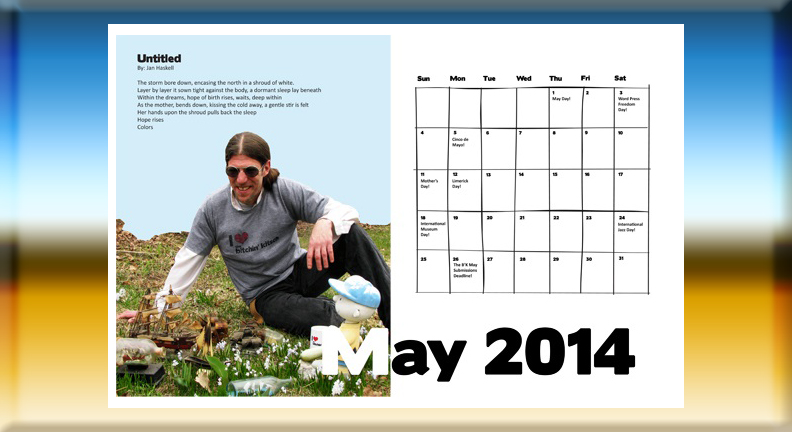
“The Embarcadero” was published in the May 2014 issue, on page 16 of The Bitchin’ Kitsch. “The Embarcadero” isn’t exactly a break up story (though it’s enough of a break up story that an editor once informed me they prefer not to publish break up stories). Rather, it’s about a missed connection. I think most people have seen love thwarted by circumstances that would otherwise seem peripheral: the timing just wasn’t right. The story is also just a moment, and I will never stop being thrilled by the narrative potential of small and insignificant acts.
Editor Chris Talbot-Heindl bio:
is a queer, trans nonbinary, triracial (white, Japanese, and Indigenous) artist, educomics creator, and nonprofit laborer trying to build spaces ready to celebrate when they turn up authentically.
They have over two decades of experience working with environmental and LGBTIQA2+ nonprofits in every capacity from dedicated database volunteer, event assistant, office manager, volunteer manager, communications director, social media manager, database manager, membership and donation manager, curriculum developer and manual designer, Moodle administrator, branding and marketing creator, graphic designer, web designer, illustrator, and everything in-between. They pride themselves on being a Jesse-of-All-Trades, learning new skills as needed to accomplish what needs doing.
Chris has over four decades of experience living in a white-, cis-, het-, abled-supremacist society and 25 years’ worth of DEI training aimed at helping them navigate this world in their body. As such, they center and advocate for equity at the forefront of everything they do. If you aren’t ready to do the work with inclusion, equity, accessibility, and justice at the forefront, working with Chris won’t be a good fit. You have to be willing, ready, and excited to do this work.
Serving House is defunct, but read the story online here.
“Those Lonely, Lonely Nights,” was published in Issue 9 of Serving House Journal. The story is about a conversation with a methamphetamine addict in a bar in Santa Cruz. If there’s a deep truth to be plucked from this story, it might have something to do with the ways that our hedonism blinds us. It might also be about a man willing to put himself halfway in danger, but never all the way.
The Serving House Journal was an amazing publication that unfortunately stopped publication in 2018. Not only did this publication showcase superb contemporary literature, they had an amazing editorial staff – Duff Brenna, Clare McQueen, and Thomas E. Kennedy to name a few.
Serving House mission statement:
Serving House Journal endeavors to publish works in the literary and visual arts that will surprise, rivet, amuse, charm, enchant — even electrify— our readers.
Our mission is to play an international role in fostering and preserving the best of what the literary arts are capable of doing: writing that may impel others to become writers themselves; writing that will add to and enhance the dialogue of the arts; writing that reaffirms our belief in the inspiring possibilities of the written word.
We celebrate the imaginative voice, the authentic attitude towards the status quo “world of letters.” We like lean-edgy-elegant writing that takes on the stupefying realities of our challenging times, our thorny relationships, the political chicanery that exhausts our patience, the contraries between men, women, children, and friends.
We’re looking for work that strives to eclipse clichés, stereotypes, and mass-market formulas gleaned from what has become more and more a “reality show,” a “sit-com,” a stultifying Wal-Mart of the mind. “Expect poison from standing water,” William Blake once told us. “The cistern contains; the fountain overflows.”
Inscribe the flow of the world as you see it. Send that world to us. We promise you a fair reading.
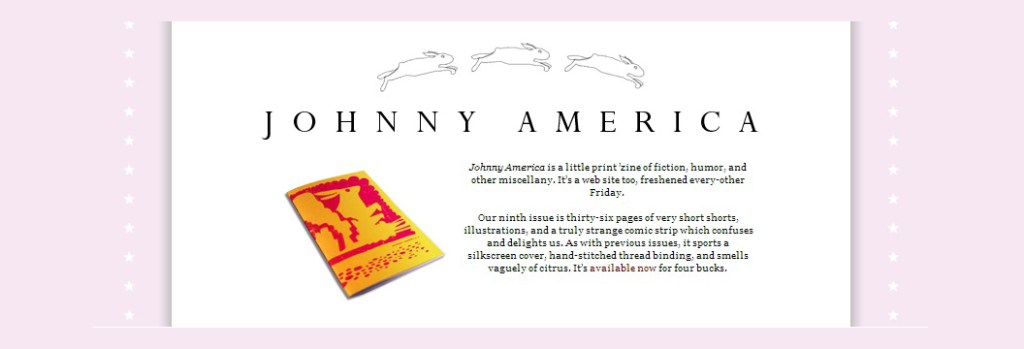
“My Love Is Going To My Love ” was published by Johnny America. The story represents not exactly a sea change, but a slow evolution in my approach to writing – more terse, less plot driven. The piece is about a man travelling to see his lover.
Johnny America manage to find some of the funniest, most entertaining fiction out there. The fact that I genuinely believe they have a brilliant eye for talent and I wrote a story deemed worthy by their editorial staff.’
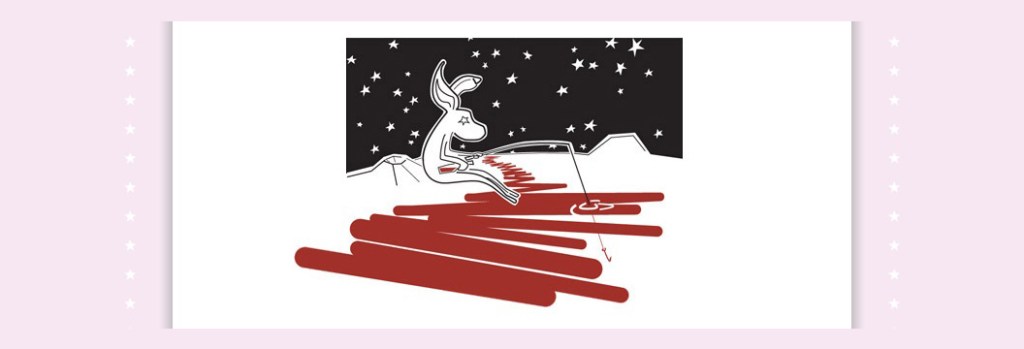
Johnny America is a large rabbit who lives in a bungalow on the Moon between two rivers of wine (one red, one white). He is the also namesake of this website of fiction, humor, and other miscellany and of the Johnny America print zine that’s published sporadically by the Moon Rabbit Drinking Club & Benevolence Society (ISSN 1553-9177).
Johnny America spends most of his days lounging against a low crater, fishing rod in paw. Some afternoons he helps plow the cheese fields — to earn extra money for carrots — but usually he’s in the valley cut by the Mercer and Mancini Rivers, idling. The fish on the Moon are constantly drunk and easy to catch. They look almost exactly like bass but taste of marmalade and cinnamon.
Sometimes we come across a zine and we’re like, “This. This is why we run a distro.” Johnny America is put together by local Lawrence folks (and fellow Rocket Grant Recipients!) Emily Lawton, Patrick Giroux, and Jonathan Holley and it hit us like a well-stocked ‘fridge dropped from space. Bam. Splat. Since 2003, Lawton, Giroux, and Holley (aka the Moon Rabbit Drinking Club) have been turning the McSweeney’s vibes of their early stuff into a whole new beast that’s all their own. Funny, smart, brave, and not afraid to take big steps into The Weird, Johnny America might be the best literary zine in the country. With a great silkscreened/stitched cover and interior design by Giroux, issue 9 is hot-damn enough to give the Paris Review a run for their money (and we say this as loyal Paris Review subscribers). Seriously, smart people of the world who have a love for short stories, beautiful ideas, and nonbullshitty things: This zine is a keeper like that big fucking rainbow trout your dad’s got on his wall.
Monongahela Review is defunct, but read the story online here.
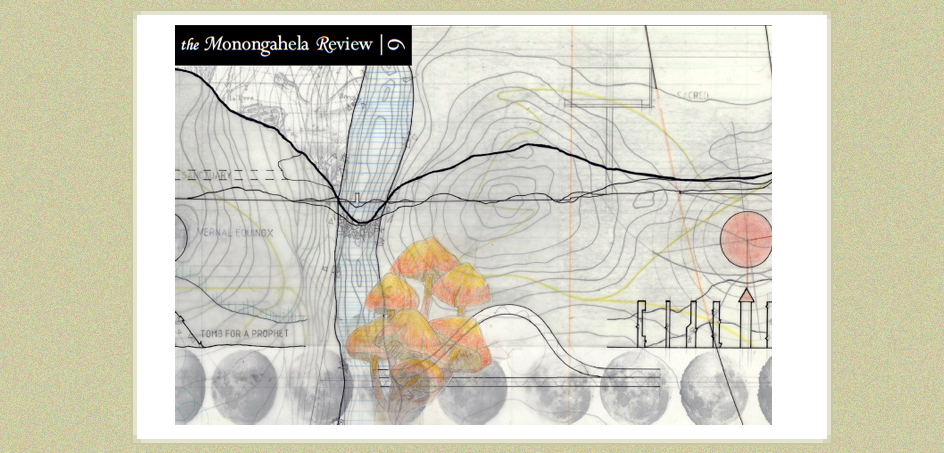
“To the Buses and Planes, I Thank You” was released in the final issue of Monongahela, on pages 20-38 of Issue 9.
The story itself addresses a theme that I often return to – public transportation. Through a series of vignettes that transpire within buses, planes, terminals, and a light rail train, a narrator describes his dissolution and his possible redemption.
The Monongahela Review wants heartache, it wants romance, it wants death, it wants joy, it wants so many things that it is hard to say exactly what it wants. One thing is sure: the work must be genuine and passionate about its subject matter. Peruse our previous issues to get a complete idea of what we like.
Go to The Monongahela Review’s website, and you won’t find out much about the journal by just browsing. Without much information or submission guidelines, you really have to read the journal to get to know it. Download the PDF or open it in Issuu, and get cozy.
Joan Colby delves into the alphabet form in her poem “Choices” which begins:
Derek Gromadzki experiments with pauses and sighs in his poem “Sospira,” setting the tone from the very beginning: “Come the being we call calm / from the motion that bodies tick out to measure time.” The repetitive “s” sounds sooth throughout, lulling as the lines move back and forth:
Brenda Lynaugh’s “A Play for Tamara” tackles an unrequited love that starts in high school and has a bit of finality now that the main character has graduated college. Visiting his best friend Tamara at her university, he feels that even though she has a boyfriend, he needs to sort out his feelings: “He’d come to see her because of their history, because maintaining friendship was important, but he knew that wasn’t the whole truth.” Is he still in love with her? Or is it lust? Are the things she does actually endearing, or does he just view it that way because he likes her? There’s no resolution, but one thing is clear, relationships are messy.
And Ping, a character from Moria Moody’s “The Great Yu,” knows this sentiment all too well. Raising her son Qi in the United States while still struggling to speak English herself, she runs into conflict as the lies she tells him about his father and the way he meshes into this new culture both drive a growing fissure in their relationship: “Ping knows her son changes with every season. He is always slipping away from her, and she studies to stay close.”
So while the website may not offer much, there is plenty of poetry and prose and art to delve into once you’re inside the issue, and there is plenty to enjoy there.
Bound Off is defunct, but the story can be read here, and listened to here.
“Climbing” was picked up by Bound Off, an audio publication. The Bound Off editors described the piece: “In Climbing, Ben Leib’s young protagonists wrangle their way through court dates and friendship.”
Though Bound Off is now defunct, it remains available to listen to online, including on Apple podcasts. I highly recommend investigating past episodes, as Bound Off consistently published incredible work for over seven years.
Bound Off is a monthly magazine of literary short stories, founded in 2006 and based in Cedar Rapids, Iowa. Our mission is to merge the oral tradition of storytelling with new technology to create a digital audio magazine. Bound Off is an independent, nonprofit organization committed to paying authors for their work. All staff are unpaid volunteers. We aspire to showcase work that is compelling and driven by narrative, with a force that keeps the listener listening. We are dedicated to publishing stories by both the established and emerging writer. In our interview on Duotrope’s Digest (an extensive, searchable database of current fiction and poetry markets), we discuss our decision-making process and you can view our average response rates.
Black and White is defunct, but you can read the story here.
“Je Vais Bien” was published in Black and White – a journal published by Red Ochre Press.
The story is a gem. It’s about a man who traps himself so deeply in a web of lies that he doesn’t see any escape. It’s a street wandering story, because there are times at which, faced with nothing else to invest one’s time in, the only thing to do is simply go outside and pretend that you have a destination.
Unfortunately Red Ochre Lit has become defunct, and the publication is no longer available for purchase. It was an admirable publication and is missed.
About RED OCHRE PRESS:
“It is a mysterious and complicated business, bringing together muscles and brain, memory and desire, and a rhythm of motions and subconscious impulses…No wonder most good writers approach writing with just a twinge of terror in their bones.” –Richard Marius
RED OCHRE PRESS exists as a publishing house and a community advocate for all things literary. We publish premier, contemporary literature. This includes poetry, fiction, nonfiction, interviews & essays. While our primary goal is to showcase the work of experienced authors, we feature emerging writers as well. A multicultural organization, we venerate voices from around the world, taking pride in writers whose work is both innovative and captivating.
This press was founded on the belief that reading and writing are becoming dying pastimes. In a world where people choose daily to flip through 1,000 channels instead of pages, writers must perfect their work and present it via widely accessible media venues. First and foremost, however, we, as writers, must lose our fear of rejection and submit polished pieces for publication.
Until next time, Editors of RED OCHRE PRESS
—
EDITOR-IN-CHIEF:
Mimi Ferebee is the editor-in-chief of RED OCHRE PRESS, overseeing the publication of RED OCHRE LiT, ROLiT NEWS, and BLACK&WHITE. While originally from California, she resides in Virginia with husband, Melvin, and son, Melthias Jai.
A graduate of the College of William and Mary, she received degrees in both English (emphasis in Creative Writing and Literature) and Psychology (emphasis in Behavioral and Developmental Science).
She recently retired a career as a clinical therapist to pursue her primary passions of writing and editing full-time. When not working on completing her novel “In the Distant Marshes” and various other literary projects, she diligently works to complete applications for doctoral programs. She wants to obtain a PhD in English Literature.
Mimi also works with at-risk youth, refining their reading and composition skills. She spends many evenings in detention centers and twice as many weekend mornings at libraries working with this population. She prides herself on being an advocate for her students, helping them not only perceive, but achieve their potential.
Her literary work has been featured recently in several journals, magazines and reviews, including Onè? Respè!, Contemporary World Literature, Decanto Magazine (United Kingdom), Both Sides Now, Flutter Poetry Journal, Leaning House Press, Caper Literary Journal, ChickenBones: A Journal, Menopause Press, Taj Mahal Review (India), Black Magnolias Literary Journal & Houston Literary Review.
Look for upcoming publications inthe award-winning journals, African American Review and phati’tude Literary Magazine. She will also have features in the revered Obsidian: Literature in the African Diaspora, James Dickey Review, Reverie: Midwest African American Literature, Pirene’s Fountain, among others.
This issue is no longer available for purchase, but the story can be read here.
—
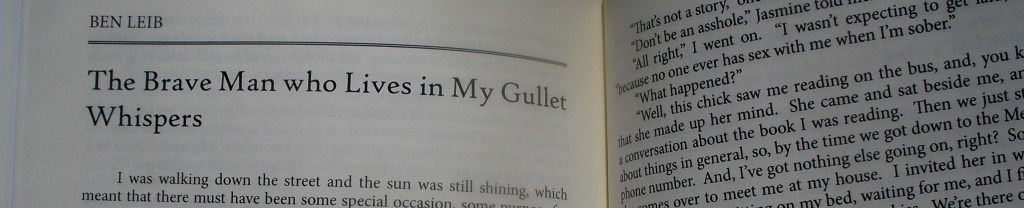
“The Brave Man who Lives in my Gullet Whispers” was published in issue 52 of Mosaic Art and Literary Magazine. I had been waiting for a publication to pick this one up for a while, and I believed all along that it was a story with more merit than most of what I end up writing. The story is about cowardice in so many of its manifestations.
—
—
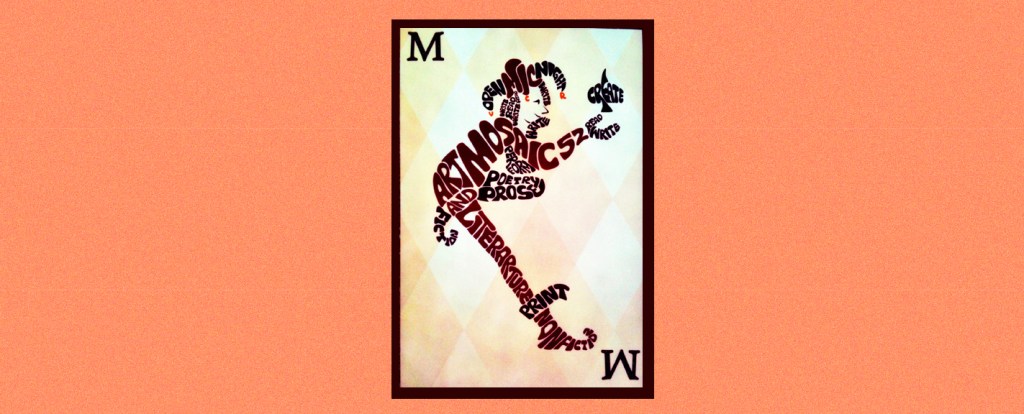
Mosaic Art and Literary is the University of California, Riverside’s undergraduate literary journal. In 1959, Mosaic began as a small group of poets, and we’re still going strong nearly 60 years later, having expanded into a home for all writers, musicians, and artists. They are completely undergraduate-run, and publish one volume of prose, poetry, and art every year. But that’s not all–we also host a number of community outreach events (including our popular Open Mic Nights) in order to promote and nurture the Riverside art and literary scene.
Pisgah Review is defunct, but read the story here.
—
“The Memoirist’s Christmas,” was published in the Summer 2012 issue of Pisgah Review. I think that sometimes, when someone’s in a particular mood, a mood that leads that person to feel as if the world cannot accommodate them, then she or he might also be led to conclude that the world is unaccommodating in general. This piece was certainly written from a place of misanthropy and the fear through which that distrust is derived.
—
—
“Pisgah” was wonderful enough to publish “The Memoirist’s Christmas,” but has since ceased publication. They operated out of the creative writing department at Brevard College, in Brevard, North Carolina.