Tag Archives: Publication

The Summerset Review – “Souvenirs”

I’ve only recently resumed submitting stories for publication, and I am as proud as can be that my short story, “Souvenirs,” has been published in the Fall 2024 Issue of The Summerset Review. The story is about a cab ride not dissimilar to one I took nearly a decade ago, and I was struck by the story the cab driver told me. I spent years considering how I might tell the story, and this was what I came up with.
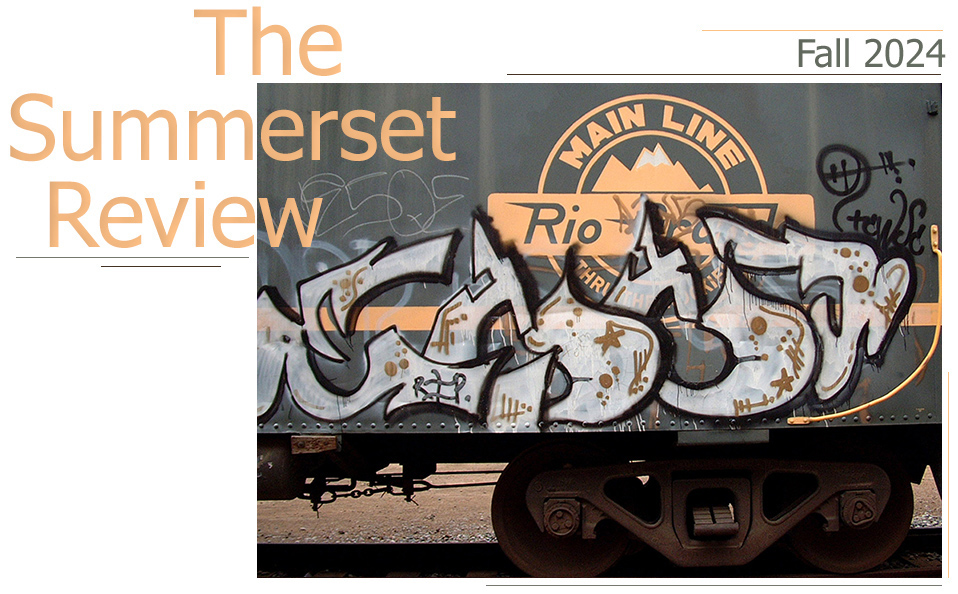
From the Summerset Review homepage:

The Summerset Review is a literary journal released quarterly on the 15th of March, June, September, and December on the Internet, and periodically in print form. Founded in 2002, the journal is exclusively devoted to the review and publication of unsolicited fiction, nonfiction, and poetry.

Staff Bios

Joseph Levens has had fiction and nonfiction appear in The Gettysburg Review, Florida Review (Editors’ Award for Fiction), New Orleans Review, AGNI, Sou’wester, Meridian, Other Voices, The Literary Review, Zone 3, The Good Men Project, and many other places. He lives on Long Island and currently teaches Creative Writing at Stony Brook University. www.josephlevens.com

Erin Murphy is the author or editor of eleven books, including Human Resources (forthcoming from Salmon Poetry of Ireland) and Assisted Living (Brick Road Poetry Prize, 2018), a collection of demi-sonnets, a form she devised. Her most recent co-edited anthology, Bodies of Truth: Personal Narratives on Illness, Disability, and Medicine (University of Nebraska Press, 2019), won the Foreword INDIES Gold Medal Book of the Year Award. Her awards include the Dorothy Sargent Rosenberg Poetry Prize, the Foley Poetry Award, the National Writers’ Union Poetry Award judged by Donald Hall, a Best of the Net award judged by Patricia Smith, and The Normal School Poetry Prize judged by Nick Flynn. She is Professor of English and Creative Writing at Penn State Altoona. www.erin-murphy.com

History of the Journal

The Summerset Review started as an online literary quarterly in 2002, publishing exclusively fiction and nonfiction. With a staff of three volunteers, the magazine faithfully produced its issues on time, reviewing unsolicited submissions year-round, the great majority of which were made electronically and sent through email from hopeful writers ranging from high school students to authors with many published books to their names.

Since 2002, the journal has taken on poetry, book reviews and art essays on occasion, and produced a few print issues collecting a sampling of work that previously appeared online. Remaining ad-free and accessible at zero cost to readers, the publication has released all quarterly issues on time over its twenty-year history. Editorial staff members are proud to say that they respond to all submissions within four months, do not solicit authors, and do not navigate a slush pile.

The Summerset Review has read at The New York Public Library, national conferences, colleges, and other places, including events sponsored by the Council of Literary Magazines and Presses (CLMP), the New York State Council on the Arts (NYSCA), the National Endowment for the Arts (NEA), the National Council of Teachers of English (NCTE), and the Association of Literary Scholars and Critics (ALSC). Print issues of the magazine are frequently donated to book fairs across the country, with all proceeds going to charitable causes in the respective areas.

Work originally published in The Summerset Review has been reprinted in the Pushcart Prize, the Best American series, the PEN America Award series, the Best of the Net anthology, notable collections such as the Iowa Short Fiction Award, and a great many books published by our contributors.

Mission Statement

We think of ourselves as simply people who like to read good contemporary literature, who want to share the best of our experiences with others. The highest form of retribution for our efforts is a lasting impact on a few sensitive readers of our journal—people we don’t know, people we will never meet. We received an email from a reader once, who said a story in our current issue (at the time) changed her life. Assuming this change was for the better, what more could we ask for?

Leave a comment

Filed under Literature, Memoir, Short Story

Existere – “Fingerprints”

Purchase the digital issue here.

“Fingerprints” appeared in Volume 37, Issue 1 of Existere, published out of Vanier College in Montreal, Quebec. Digital copies can be purchased online. “Fingerprints” is an awesome story, loosely inspired by a dear friend of mine who I love.

From the issue’s description: “Through life’s next adventure, we are faced with withstanding the heavy weight of another’s gaze. In Annie Raab’s “The Artist” and Ben Leib’s “Fingerprints,” we are shown the effects of other people’s opinions and narrow-mindedness in two vastly different ways. With Raab’s piece, we are shown the internal struggle and aftermath of inner turmoil, whereas with Leib’s piece, we watch a woman choke down her pride and principles to survive in her troubled world.

Copies of 37.1 are now available on Kobo!

Existere exists as a venue for emerging and established talent from York University and around the world. We publish poetry, fiction, visual art, interviews, reviews, essays, photographs, art, and much more from established and emerging talents. We also debut new writers, poets, and artists.

Existere publishes biannually. Contributors come from as close as Montreal to as far away as the other side of the planet.

Existere is a nationally-distributed literary magazine. It was founded and first published in 1978 as a student-run journal covering literature and poetry. In 1980, the journal began publishing regular issues. Over nearly three decades, Existere has largely published as a quarterly, but in recent years has published semi-annually. Content, focus, and presentation has varied widely over the years, but has always included poetry and short stories as its core. Photography, reviews, art, essays, and postcard stories, novel chapters, and much more have appeared on our pages. Existere will continue to be a student-run journal and publish fiction, photography, and art, but will also add more non-fiction, reviews, and criticism as we grow.

How do you pronounce Existere? It depends who you ask. Our name comes from Latin and means “to stand out” or “to stand apart.” Therefore is should be pronounced ex-iss-TAIR-AY. However, being that Latin is not in as common usage as it once was, many refer to our name as EX-ISS-STAIR. Either is fine. We’re just happy to have you pick up a copy and enjoy our contributors.

Existere has a listing on Wikipedia (help us with our history), a fan site on Facebook (post your comments, we want to hear from you), and a Twitter account (ExistereJournal).

Leave a comment

Filed under Literature, Short Story

Little Patuxent Review – “The Augury”

“The Augury” was published in the 19th issue of Little Patuxent Review and remains available to purchase. I love the piece – it’s brief and was written in transit, and at the present time it reminds me of adventure and unfamiliarity.

Little Patuxent Review is an amazing magazine out of Maryland. It’s a print publication, and a copy of issue 19 costs $12. You can order the issue or subscribe to Little Patuxent Review here.

About Little Patuxent Review:

Little Patuxent Review (LPR) is a journal of literature and the arts, publishing poetry, short fiction, creative nonfiction and artwork. LPR welcomes most US-based contributors and prides itself on supporting both up-and-coming and well-established artists and writers. Please see our submission guidelines for more details.

LPR’s mission is to promote the tradition of literary and visual arts through our:

LPR reflects and draws upon the creativity and diversity of the Mid-Atlantic region and beyond by promoting the literary and visual arts in print and throughout the region’s community and educational venues.

Each subscription to LPR supports the arts in your community. You get two amazing issues per year for only $24. Subscribe today!

Water over stone: Little Patuxent River, Spring 2012 (Photo: Lynn Weber)

LPR was named for Little Patuxent River, one of the three major tributaries of the Patuxent River. Like LPR, the river flows over stones — the Algonquin word “patuxent” means “water flowing over smooth stones” — through Howard County, Maryland, gathering strength as it carries content to the Chesapeake Bay and out toward the larger world.

LPR was founded in 2006 by a group of local writers — Mike Clark, Ann Bracken, Ann Barney, Brendan Donegan — to fill the void left when a periodical of the same title, founded by poets Ralph and Margot Treital, closed a quarter century ago.

They envisioned LPR as a forum for area writers and artists. In doing so, LPR not only provides readers with a diverse array of local offerings, but also attracts contributors of national repute.

LPR has featured poetry from Donald Hall, Poet Laureate of the United States and Michael Glaser, Poet Laureate of Maryland. In addition, from Delmore Schwartz Memorial Award winner Stanley Plumly, the late Lucille Clifton, winner of the 2000 National Book Award for Poetry and recipient of the Robert Frost Medal for Lifetime Achievement from the Poetry Society of America and Joy Harjo, recipient of the Lifetime Achievement Award from the Native Writers’ Circle of the Americas.

There has been fiction from Edith Pearlman, whose collection Binocular Vision: New and Selected Stories won the 2011 National Book Critics Circle Award,  Michael Chabon, whose Amazing Adventures of Kavalier & Clay won the 2001 Pulitzer Prize for Fiction, Rafael Alvarez, whose screenwriting contributed to the critically acclaimed television series Homicide: Life in the Streets and The Wire, and Manil Suri, whose The Death of Vishnu became an international bestseller.

There have been myriad early efforts from writers and artists who will look back on Little Patuxent Review as the publication that gave them their start

Leave a comment

Filed under Literature, Memoir, Short Story, Travel