Tag Archives: Short Story

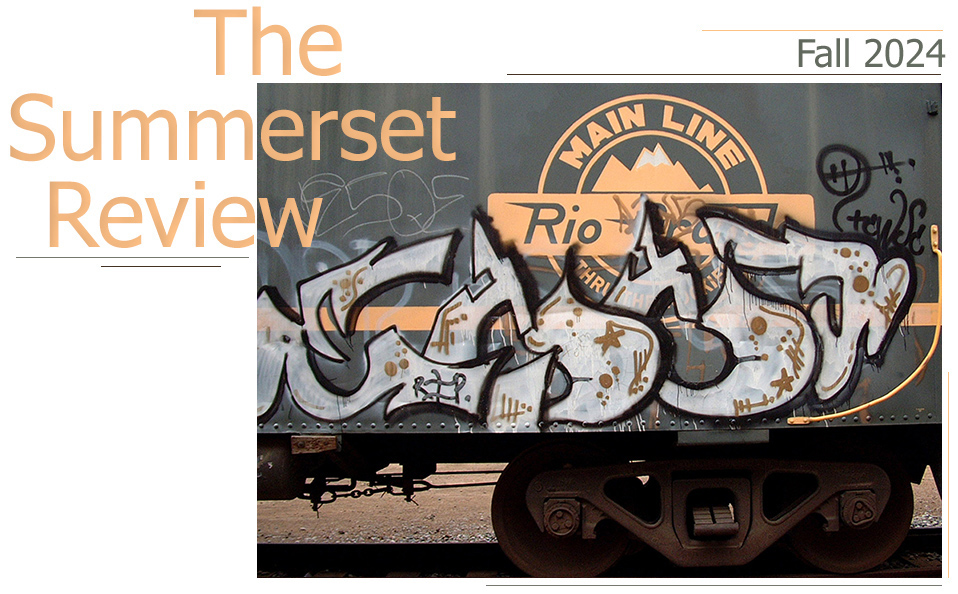
The Summerset Review – “Souvenirs”

I’ve only recently resumed submitting stories for publication, and I am as proud as can be that my short story, “Souvenirs,” has been published in the Fall 2024 Issue of The Summerset Review. The story is about a cab ride not dissimilar to one I took nearly a decade ago, and I was struck by the story the cab driver told me. I spent years considering how I might tell the story, and this was what I came up with.

From the Summerset Review homepage:

The Summerset Review is a literary journal released quarterly on the 15th of March, June, September, and December on the Internet, and periodically in print form. Founded in 2002, the journal is exclusively devoted to the review and publication of unsolicited fiction, nonfiction, and poetry.

Staff Bios

Joseph Levens has had fiction and nonfiction appear in The Gettysburg Review, Florida Review (Editors’ Award for Fiction), New Orleans Review, AGNI, Sou’wester, Meridian, Other Voices, The Literary Review, Zone 3, The Good Men Project, and many other places. He lives on Long Island and currently teaches Creative Writing at Stony Brook University. www.josephlevens.com

Erin Murphy is the author or editor of eleven books, including Human Resources (forthcoming from Salmon Poetry of Ireland) and Assisted Living (Brick Road Poetry Prize, 2018), a collection of demi-sonnets, a form she devised. Her most recent co-edited anthology, Bodies of Truth: Personal Narratives on Illness, Disability, and Medicine (University of Nebraska Press, 2019), won the Foreword INDIES Gold Medal Book of the Year Award. Her awards include the Dorothy Sargent Rosenberg Poetry Prize, the Foley Poetry Award, the National Writers’ Union Poetry Award judged by Donald Hall, a Best of the Net award judged by Patricia Smith, and The Normal School Poetry Prize judged by Nick Flynn. She is Professor of English and Creative Writing at Penn State Altoona. www.erin-murphy.com

History of the Journal

The Summerset Review started as an online literary quarterly in 2002, publishing exclusively fiction and nonfiction. With a staff of three volunteers, the magazine faithfully produced its issues on time, reviewing unsolicited submissions year-round, the great majority of which were made electronically and sent through email from hopeful writers ranging from high school students to authors with many published books to their names.

Since 2002, the journal has taken on poetry, book reviews and art essays on occasion, and produced a few print issues collecting a sampling of work that previously appeared online. Remaining ad-free and accessible at zero cost to readers, the publication has released all quarterly issues on time over its twenty-year history. Editorial staff members are proud to say that they respond to all submissions within four months, do not solicit authors, and do not navigate a slush pile.

The Summerset Review has read at The New York Public Library, national conferences, colleges, and other places, including events sponsored by the Council of Literary Magazines and Presses (CLMP), the New York State Council on the Arts (NYSCA), the National Endowment for the Arts (NEA), the National Council of Teachers of English (NCTE), and the Association of Literary Scholars and Critics (ALSC). Print issues of the magazine are frequently donated to book fairs across the country, with all proceeds going to charitable causes in the respective areas.

Work originally published in The Summerset Review has been reprinted in the Pushcart Prize, the Best American series, the PEN America Award series, the Best of the Net anthology, notable collections such as the Iowa Short Fiction Award, and a great many books published by our contributors.

Mission Statement

We think of ourselves as simply people who like to read good contemporary literature, who want to share the best of our experiences with others. The highest form of retribution for our efforts is a lasting impact on a few sensitive readers of our journal—people we don’t know, people we will never meet. We received an email from a reader once, who said a story in our current issue (at the time) changed her life. Assuming this change was for the better, what more could we ask for?

Leave a comment

Filed under Literature, Memoir, Short Story

October 18, 2018: The Butterfly as Symbol For Resurrection

I haven’t published much lately, but have maintained my writing practice over the past several years. I’ve been journaling, but sometimes my entries devolve into meditations, some of which I think are worthy of sharing. I hope to post more of these meditations over time, and the first one I’ve chosen with the holiday season in mind.

October 20, 2018

Arielle’s parents’ bathroom has a strand of twine crossing from wall to wall, supporting two dozen bright green chrysalis. They were the green of dreams of springtime fields when droughts and dust were a twinkle in the eye of the creator. A kinetic green, each with similar and alien markings, dots of polished gold. There was a fingernail shaped line of these golden dots along the top of each chrysalis. There were also two dots towards the bottom of each, right where the eyes might be. And the chrysalis itself bore the veins and markings, a kind of hieroglyphic representation, of where the wings would be and where the head would be. But inside there was no butterfly.

There was also no caterpillar any longer, because it had sloughed off all of its butterfly identity. Arielle had shown me a video of this process. The caterpillars, themselves beautifully ringed in yellow, white, and black, would choose a moment, a warm instant, and decide that it was time to pupate. They would climb to an elevated space, affix their proboscis to the roof with strands of filament, and then hang for some time before the first change. The caterpillar hung from its tail in a hook form and the first part to split was the back of its head. The body of the creature writhed, and the brilliant green shown from out of the split in the flesh. The body would whip and like that the head was split open revealing the dreamlike verdant underneath.  

And soon the laceration would grow, and more of the green appear, and the black and yellow flesh shed from the head up, so that, by the end of the process, the green and writhing pod had freed itself from the container of flesh, which hung desiccated and weightless from the same filament that now held the chrysalis aloft. And then, with another few wriggles, the skin, head and all, dropped free and fell to the bottom of the tank. And in time, the green and gold begins to fade, the substance of the chrysalis turns transparent as rice paper, and the wings and the thorax become visible through their container. And then the monarch frees itself, an orb of liquid in its thorax which stretches and flexes and pumps life into the beautiful, delicate wings.

In medieval times, the butterfly was seen as a symbol of the resurrection. The caterpillar was the earthbound and begrimed creature. But, in time, its earthly coil was shed, sloughed off and discarded and left behind. And then, from the primordial essence comes the butterfly, a beauty so stunning, so contrary to the worm from which it was formed, that it could seem divine. The wings expand, stiffen, retract, and the animal takes flight. And we, too, strive to become this after abandoning our own tenement of clay. And in this sense, the butterfly is a symbol for our own transcendence, for the way which a body is left but a soul takes flight. The terrestrial is abandoned for the heavenly.

But when the butterfly is the symbol for transcendence, what becomes of identity? Does one’s personhood transcend as well? Does the Butterfly retain anything of the caterpillar? I was reminded of an episode of a radio show, Radiolab, I’d once heard, that discussed the symbology of this metamorphosis. In that episode, “Black Box” (first aired January 16, 2014), their producer, Molly Webster, met with a lepidopterist, in whose lab were thousands of living butterflies of all varieties. The scientist takes a pupa from the ceiling, lays it onto the examination board, and slices open the flesh of the chrysalis. There is nothing of the caterpillar inside. Nor is there any indication that a butterfly might emerge. All that exists is the intermediate plasm of existence, the thing that separates the unformed from the formed.

On one hand, the symbolic ideal is to shed all earthly blight, to rid oneself of the terrible stain of having inhabited a body that ages and desires and swells and cracks. And in regard to the caterpillar and butterfly, there is an intermediary stage, the chrysalid, during which all signs of caterpillar have been erased. If one were to open up the chrysalid, only a paste would emerge. Nothing is left of the original creature.

Carolyn Walker Bynum, in the chapter of her book, Metamorphosis and identity, “Metamorphosis, or Gerald and the Werewolf,” writes:

“In The Resurrection of The Body in Western Christianity, I connected the extreme literalism and materialism of twelfth-century notions of resurrection at the end of time with a fear of metempsvchosis, of loss of self through loss of body, or – to put it another way – with a pervasive conviction, underlying many genres and divergent discourses of the period, that the human person is a psychosomatic unit whose survival necessitates bodily continuity…”

In the twelfth century, theologians and philosophers wondered about the complications of a bodily continuity as it regarded issues of resurrection. Would a baby child be resurrected in the most perfect moment of a hypothetical life? Because what would be the benefit of resurrecting a baby incapable of rational thought or satisfying human agency? On the other hand, if one lived into senility, in what form would that person return? Would there be an ideal-self separate from the body? In this sense, the body that one inhabits is relevant – it is the vessel through which a resurrection will be engendered.

Bynum goes on:

“Orthodox attacks on heretics for metemsychosis – that is, body-hopping, body-exchange, or body-erasure – came, I argued, at the height of Western understanding of resurrection as materialist and literal. Scholastic and monastic discussions of the twelfth and early thirteenth centuries saw an embodied self as locus of identity and connected this identity with triumph over change, over physical process and decay. Bodily resurrection was thus both supernatural and natural. It is natural for the human person to have a body, and survival of soul alone is hence an aberration that cannot be perpetual; but divine power is necessary, for in the natural order biological entities give birth only to like, but numerically separate, individuals (additional instances of the species).”

Because the body is the locus of identity, resurrection presented complications to twelfth and thirteenth century scholars. The soul could not exist independently of the vessel and the vessel at death and after succumbs to putrefaction. Thus, the decay inflicted on the inanimate body indicate the earthly deteriorations, the aging and changing, the impermanence that Christian tradition has had such a pathological horror of. The body cannot be reincarnated in its deathly form.

And yet, without the original body, with the idealized and angelic transformation that the butterfly represents, the body is left behind and a new form is taken. As Bynum notes, the fear of metempsychosis is connected with “a pervasive conviction… that the human person is a psychosomatic unit whose survival necessitates bodily continuity.” Furthermore, “monastic discussions of the twelfth and early thirteenth centuries saw an embodied self as locus of identity…” Hence, the symbol of the butterfly becomes problematic when one takes into consideration the belief that identity will be wholly lost if the body is not retained. If the soul is to animate a new form, the original identity will be lost with the original form.

“Roger Bacon, using conventional arguments that entities give birth only to like but separate instances, not to the same instance, maintains that bodily resurrection (return of the same instance) is possible because God reduces body to prime or first matter and induces the same form in it again.” In this sense, even the body is re-formable from Materia Prima, the material from which all the material is formed. Or, more exactly, material that formed the perfect models for all degraded forms of existence. Hence, the soul would have to inhabit that same body – body is still requisite for continuity of identity – but, as formed from first matter, the body is regenerated in its ideal form, perhaps a form it had never taken before – as in the case of the deceased baby who is reincarnated as a grown human.

So though the butterfly is an inspiring metaphor for the resurrection in our idealized forms, the question persists: what of the original caterpillar is preserved in the butterfly. The two forms are so distinct as to seem incomparable. The second entirely unique, so that the first has been subsumed. This erasure of the body could be seen as an existential threat within an ethos that deified continuity and abhorred degeneration.

In his essay, “How Did Insect Metamorphosis Evolve?” Ferris Jabr discusses early enlightenment understandings of the caterpillar metamorphosis:

“1651 English physician William Harvey published a book in which he proposed that caterpillars and other insect larvas were free-living embryos that abandoned nutrient-poor “imperfect eggs” before they matured. Harvey further argued that the cocoon or chrysalis a caterpillar entered during its pupal stage was a second egg in which the prematurely hatched embryo was born again. He entertained the idea that a caterpillar was one creature and a butterfly was an entirely different beast.”

The valuation of these forms of existence persisted in the seventeenth century, in the musings of scientists whose enlightenment thinking was moving them further and further from recourse to divinity, establishing the ideology of experimentation, observation, proof, and analysis. But the ideological inception of these valuations remained rooted in Christian tradition. The ground-dwelling insect was born of imperfection. The cocoon was a second egg, and the embryo was born again, an elevated animal, one of an entirely different species. What was flawed and terrestrial and undeveloped in the first lifeform became an “entirely different beast” in its second life.

In the chapter of Bynum’s book titled, “Shape and story”, Bynum offers varying definitions of identity:

“Finally, identity can mean spatiotemporal continuity. In this sense, identity refers to the fact that I am the same person I was a moment ago. This third understanding of identity carries the connotation of oneness or integrity… it offers the deepest and rawest threat to our grounding as a self. For considering identity in this sense raises doubts about whether anything perdures – my personality, my cat, my briefcase if I take my eye off it for even a moment. If I have amnesia, does my body guarantee that I am “me” over time? What if it then undergoes a sex-change operation and complete cosmetic surgery? Is there any sense in saying that such an altered entity is “the same individual,” whereas a donor mouse and its clone are two separate individuals?”

The fear is that the butterfly, in its absolute difference from the thing out of which it was formed, will retain nothing of the caterpillar. In the terms of a symbology, the parallel would mean that the self would be completely subsumed in the act of resurrection. But selfhood, personal identity and individuality, had become so much of what we yearned to retain in western traditions. To lose the self in resurrection would not be resurrection at all. The consciousness was embodied in the form and without the form, the self would vanish. In crude terms, who would care if the butterfly left the chrysalis as the most beautiful and angelic form imaginable, it isn’t a desirable inevitability if the caterpillar is not there to enjoy her new existence. What would the promise of resurrection be if the person was lost?

Molly Webster, producer of Radiolab, touches on this exact dilemma. So, she asks, what is maintained from one form to the next? In that podcast, she talks to Marth Weiss, a professor of environmental studies at Georgetown University. Weiss had been able to condition the caterpillars to detest a specific odor by way of negative reinforcement (shocking them). The caterpillars were then allowed to pupate, and Weiss discovered that the moth that emerged would also be adverse to the odor. “My feeling is, Wow. I think it’s amazing that a caterpillar can have an experience, go into its chrysalis, five weeks pass, emerge as a seemingly different organism, and that it still can recall experiences that happened to it when it was a caterpillar.” What this ostensibly meant is that a speck of the brain is preserved. The butterfly retained a spark of the identity the caterpillar passed along, via the intermediary substance of the pupal stage, via some sort of bodily continuity.

When I reconsidered the video that Arielle had shown me, I remembered the markings that remained around the chrysalis once the caterpillar skin had fallen free. I could make out the markings of the caterpillar from which it was it was molded – visible in the subtly yellow rings, the crescent of golden dots. And looking at the chrysalises that hung in Arielle’s bathroom, I could see, etched in the green flesh, features of the butterfly to come, outlines of wings and thorax, the casing dotted with gold like the nodes of a blueprint.

In regards to the English physician William Harvey, Ferris Jabr writes:

“Some of Harvey’s ideas were prescient, but he mostly misinterpreted what he observed. In 1669 Dutch biologist Jan Swammerdam rejected Harvey’s notion of the pupa as an egg and the butterfly as a different animal than the caterpillar. Swammerdam dissected all kinds of insects under a microscope, confirming that the larva, pupa and adult insect were phases in the development of a single individual, not distinct creatures. He showed that one could find immature moth and butterfly body parts inside a larva, even before it spun a cocoon or formed a chrysalis. In some demonstrations, for example, Swammerdam peeled the skin off silkworms—the larval stage of the domesticated silk moth (Bombyx mori)—to reveal the rudimentary wings within.”

The butterfly was always already inside the caterpillar. The architecture had been forming in there all along. Swammerdam had been able to open up the body of the caterpillar, part the flesh, and show that, along the inside walls of the creatures, “one could find immature moth and butterfly body parts inside a larva, even before it spun a cocoon or formed a chrysalis.”

Which mean that the caterpillar was already born with the form its resurrected self as a physical part of its own body. The identity of the creature’s reemergence was formed as a hidden part of its physical structure. In this case, the identity of the caterpillar is not lost. Rather, the identity of the soul in ascendance is established before the animal has ever entered the pupal stage. So that the identity of the soul is developing in the body before the body knows or perhaps despite the body not knowing that it is already incubating the transcendental part of its self. The identity is something that forms around the soul, and perhaps the soul is a means of conveyance for that identity. Regardless, the body is already generating the structure for ascendance, the means of conveyance away from the gross physical world. As Molly Webster asks, “What of my future self is in me now?”

Symbolically, the caterpillar predetermines the structure of its ascendance. But, as Matthew Cobb, professor of zoology, acknowledges in Radiolab, the biological truth of the organism reveals that the process is not at all about death and resurrection. Rather, it is about the continuity of life. That, in itself, when considering notions of afterlife, or of the ascendance of the soul, reintroduces anxieties about identity, because even if the soul retains the identity, it is also not being reborn, but is existing continuously as variations of the earthly form.

The lifespan of the caterpillar is also, perhaps, not a fitting a metaphor for the earthly lifecycle of humanity. We rarely experience the moment of incubation and rebirth. We rarely undertake the departure as one person only to return as another, imbued with the wisdom and insight of one who had “grown wings” so to speak. This metaphor is much more evocative of a growth moment, a sort of sea change, catalyzed by specific events or experiences.

Furthermore, the continuity that we see in the butterfly, the preconceived form determining the post-development, post-transformation form, has its complications for the questions of identity. For, though we find in the body the locus for identity, we also refuse to consider that identity may be out of our control. The sense of selfhood is something shaped and determined, something manipulable and representable – something that we consciously embrace and represent (typically through consumerist choices).

In the contemporary, technological world, this can be seen in the curation of self-hood via electronic forms and social media platforms. A person is no longer an identity limited to the confines of a body, but is now a compendium of the various artifacts that are shared universally, the combination of which is unique to that person alone. The formation of identity, the development of the form that we will inevitably become, is not something that remains a physical and anatomical predetermination, but is a work in progress, as self-curative project that is always a matter of self-selection.

I personally would have feared the notion of a biological determination of the soul, and continue to fear such things. This is not because I want to believe that I am in control of my own identity. Rather, I glory in the mystery that I do not know how I have become. Biological determinism is defeatist and leaves little room for change and growth. If my butterfly precedes me, then what is the point of personal growth when my ascendance has already been written? The same can be said of genetic determinism. If the soul that animates me is a matter of the genes that I’ve inherited, then what of every decision I’ve ever made? Was there any agency at all? What is the purpose of deciding? What is the purpose of struggle and pursuit? Conversely, why try to change and grow and become better as a human among humanity? Because that too would be lost in a deterministic understanding of human identity.

Nevertheless, there is relief in considering that the person I am has some physiological or biological or spiritual foundation that precedes the influence of all cultural signifiers. Arielle and I had been discussing, before ever considering the relevance of butterflies or identity, the Marxian notion of reification, as was later developed by Herbert Marcuse. In the Marxian conception of the term, reification represented the moment when the human becomes something written, something without agency. Counter-intuitively, objects had become the active, agential, generators of meaning. The object is the performer of identity. The consumer, thus unwritten, accepts the identity bestowed by the ownership of things.

Marcuse went further to discuss the ways in which human desires were not actually a matter of personal tastes, but were a product of a market system that peddled in identity. We mistakenly believe that identity is a factual and measurable substance, as determined by the cultural signifiers that one accumulates. The signifiers themselves – the music or art one likes, the political beliefs one has, down to the secret desires one experiences – are all collected from a vast trove of cultural ephemera, and that ephemera is the million billion dust motes of a capitalist system in which identity has become commoditized. If there is a core and unalterable potential self that precedes all of acculturation, then perhaps there is hope that the substance of human identity can be re-centered in physical and experiential activity, rather than hypostatization and consumption.

Bynum, C. W. (2005). Metamorphosis and identity. Zone.

Jabr, Ferris, “How Did Insect Metamorphosis Evolve?” Scientific American, SCIENTIFIC AMERICAN, a Division of Springer Nature America, Inc., Aug 10, 2012. https://www.scientificamerican.com/article/insect-metamorphosis-evolution/

WNYC Studios, RadioLab, “Black Box”, First Aired Jan 17, 2014. https://radiolab.org/podcast/black-box

Marcuse, H. (1987). Eros and civilization. Routledge.

Leave a comment

Filed under Blog Posts, Literature

Existere – “Fingerprints”

Purchase the digital issue here.

“Fingerprints” appeared in Volume 37, Issue 1 of Existere, published out of Vanier College in Montreal, Quebec. Digital copies can be purchased online. “Fingerprints” is an awesome story, loosely inspired by a dear friend of mine who I love.

From the issue’s description: “Through life’s next adventure, we are faced with withstanding the heavy weight of another’s gaze. In Annie Raab’s “The Artist” and Ben Leib’s “Fingerprints,” we are shown the effects of other people’s opinions and narrow-mindedness in two vastly different ways. With Raab’s piece, we are shown the internal struggle and aftermath of inner turmoil, whereas with Leib’s piece, we watch a woman choke down her pride and principles to survive in her troubled world.

Copies of 37.1 are now available on Kobo!

Existere exists as a venue for emerging and established talent from York University and around the world. We publish poetry, fiction, visual art, interviews, reviews, essays, photographs, art, and much more from established and emerging talents. We also debut new writers, poets, and artists.

Existere publishes biannually. Contributors come from as close as Montreal to as far away as the other side of the planet.

Existere is a nationally-distributed literary magazine. It was founded and first published in 1978 as a student-run journal covering literature and poetry. In 1980, the journal began publishing regular issues. Over nearly three decades, Existere has largely published as a quarterly, but in recent years has published semi-annually. Content, focus, and presentation has varied widely over the years, but has always included poetry and short stories as its core. Photography, reviews, art, essays, and postcard stories, novel chapters, and much more have appeared on our pages. Existere will continue to be a student-run journal and publish fiction, photography, and art, but will also add more non-fiction, reviews, and criticism as we grow.

How do you pronounce Existere? It depends who you ask. Our name comes from Latin and means “to stand out” or “to stand apart.” Therefore is should be pronounced ex-iss-TAIR-AY. However, being that Latin is not in as common usage as it once was, many refer to our name as EX-ISS-STAIR. Either is fine. We’re just happy to have you pick up a copy and enjoy our contributors.

Existere has a listing on Wikipedia (help us with our history), a fan site on Facebook (post your comments, we want to hear from you), and a Twitter account (ExistereJournal).

Leave a comment

Filed under Literature, Short Story

Blacktop Passages – “Always the Lucky One”

You can read the story here.

Blacktop Passages published my short story “Always the Lucky One,” about the narrator’s superstitious descent into lucklessness. Though I was proud to have it published by Blacktop Passages, the publication has since ceased publication.

About Blacktop Passages:

Founded in early 2013, Blacktop Passages is a literary journal dedicated to the open road. We want to serve as a home for the stories, essays, poems, and images of transition that are often overshadowed by our destinations. We want thoughtful writing, full of feeling, conflict, and desire. If you have a great piece that reflects this ethos, Blacktop Passages would love to have your work in our pages.

Leave a comment

Filed under Literature, Memoir, Short Story, Travel

Emrys – “Aluxes”

Read the story here.

I was submitting to Emrys for years when they accepted my story, “Aluxes,” to appear in Volume 33. Unfortunately, the publication is currently on indefinite hiatus. They had thrived for nearly 40 years before shuttering.

In the words of Wikipedia, “Alux is the name given to a type of sprite or spirit in the mythological tradition of certain Maya peoples from the Yucatán Peninsula and Guatemala. Tradition holds that aluxo’ob are invisible but able to assume physical form for purposes of communicating with and frightening humans as well as to congregate. They are generally associated with natural features such as forests, caves, stones, and fields but can also be enticed to move somewhere through offerings.” That said, this story has nothing to do with aluxo’ob, aluxes, or any other mythological figure. It’s about two friends who elicit local help to locate a cave in a rural region of the Yucatan Peninsula.

Emerys Mission Statement:

Founded in 1983, Emrys (a Welsh word meaning “Child of Light”) has sponsored music competitions, concerts, art exhibitions, conferences, creative writing awards, poetry workshops, and lectures. The Emrys Journal, our group’s signature literary publication, has appeared annually since 1984. Emrys Press, launched in 1995, primarily publishes poets of outstanding merit. Our Reading Room has brought writers and audiences together since 1990. Our Writing Room has provided professional instruction for writers at all stages of their craft since 2006 and begun in 2011, our Open Mic, which has provided a venue for writers of all skill levels to present their work to an enthusiastic and supportive audience.

Based in Upstate South Carolina, the Emrys Foundation was awarded the Elizabeth O’Neill Verner Governor’s Award for the Arts in 2004 in recognition of outstanding contributions to the arts in South Carolina.

➢ Emrys nurtures creativity among emerging and established writers.
➢ Emrys seeks to expand the impact of the literary arts.
➢ Emrys collaborates across a broad variety of art forms to give voice to the written word.

We invite you to join our award-winning organization.

Emerys History:

On the night of April 2, 1981, a special musical performance took place at Furman University. Everyone involved had ties to Greenville: the librettist, Keller Cushing Freeman, the musical composer, Sally Wyche Coenen, and the singers. The event was the premiere performance of an original song cycle called The Death of Arthur: a Requiem for Six Voices. The singers represented important characters in the life of the legendary king of the Round Table.

The Death of Arthur was the first public appearance of Emrys, but it had its real beginning when two friends dreamed, planned, and worked to make some ambitious ideas come to fruition. Who better to tell about this than one of the co-founders, Keller Cushing Freeman:

“It wasn’t quite the first act of Puccini’s La Boheme, where a cluster of young artists and poets shared their dreams and a bottle of vin ordinaire in a Paris garret. But it was close. Our setting was a basement apartment on Constitution Avenue in Washington, D.C.  Serving up the cabernet was Dan Coenen, a law clerk for U.S. Supreme Court Justice Blackmun. Tossing the salad was Dan’s wife, Sally Wyche Coenen, a native of Greenville, S.C., currently taking photography courses and continuing her study of piano with Spencer Fellows. Sally also harbored ambitions as a composer, although 1980 was not a year when the world clamored for the music of emerging young composers—male or female. To date Sally had not had even the nibble of a commission.

“I was the fortunate dinner guest that icy winter evening, warmed by more than 20 years of friendship with Sally and the Wyche family. Like Sally, I, too, had a closet stuffed with dreams. Although teaching philosophy was my day job, I wrote poetry on the sly. Recently I’d completed a series of poems based on the legends of King Arthur. The material seemed made for music, so I labeled the poems lyrics and set off to find a composer to collaborate on a song cycle. Sally was my first choice.

“That evening over melting bowls of ice cream we reflected on the obstacles confronting writers, composers, and artists who were in sore need of a place to present their work, an audience to receive the work, and a patron to subsidize the projects. Without realizing it, we had begun to articulate the mission statement for the organization that was to become The Emrys Foundation—to promote excellence in the arts, especially literary, artistic, and musical works of women and minorities.

“Nearly a year later we felt ready to present our first collaboration, a song cycle for piano (later scored for chamber orchestra), narrator and six voices.

“To choose a name for our new partnership we turned to Welsh lore that had inspired our first collaboration. Learning that King Arthur’s sorcerer, Merlin, was actually named Emrys, we agreed that this rather mysterious word had a special ring to it. When we discovered that Emrys was translated Child of Light, we felt certain that this was a name of good omen.”

Leave a comment

Filed under Literature, Memoir, Short Story

Little Patuxent Review – “The Augury”

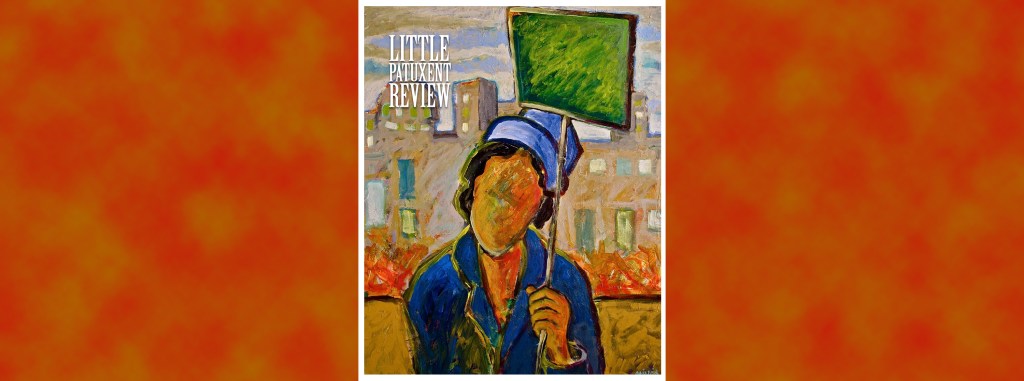
“The Augury” was published in the 19th issue of Little Patuxent Review and remains available to purchase. I love the piece – it’s brief and was written in transit, and at the present time it reminds me of adventure and unfamiliarity.

Little Patuxent Review is an amazing magazine out of Maryland. It’s a print publication, and a copy of issue 19 costs $12. You can order the issue or subscribe to Little Patuxent Review here.

About Little Patuxent Review:

Little Patuxent Review (LPR) is a journal of literature and the arts, publishing poetry, short fiction, creative nonfiction and artwork. LPR welcomes most US-based contributors and prides itself on supporting both up-and-coming and well-established artists and writers. Please see our submission guidelines for more details.

LPR’s mission is to promote the tradition of literary and visual arts through our:

LPR reflects and draws upon the creativity and diversity of the Mid-Atlantic region and beyond by promoting the literary and visual arts in print and throughout the region’s community and educational venues.

Each subscription to LPR supports the arts in your community. You get two amazing issues per year for only $24. Subscribe today!

Water over stone: Little Patuxent River, Spring 2012 (Photo: Lynn Weber)

LPR was named for Little Patuxent River, one of the three major tributaries of the Patuxent River. Like LPR, the river flows over stones — the Algonquin word “patuxent” means “water flowing over smooth stones” — through Howard County, Maryland, gathering strength as it carries content to the Chesapeake Bay and out toward the larger world.

LPR was founded in 2006 by a group of local writers — Mike Clark, Ann Bracken, Ann Barney, Brendan Donegan — to fill the void left when a periodical of the same title, founded by poets Ralph and Margot Treital, closed a quarter century ago.

They envisioned LPR as a forum for area writers and artists. In doing so, LPR not only provides readers with a diverse array of local offerings, but also attracts contributors of national repute.

LPR has featured poetry from Donald Hall, Poet Laureate of the United States and Michael Glaser, Poet Laureate of Maryland. In addition, from Delmore Schwartz Memorial Award winner Stanley Plumly, the late Lucille Clifton, winner of the 2000 National Book Award for Poetry and recipient of the Robert Frost Medal for Lifetime Achievement from the Poetry Society of America and Joy Harjo, recipient of the Lifetime Achievement Award from the Native Writers’ Circle of the Americas.

There has been fiction from Edith Pearlman, whose collection Binocular Vision: New and Selected Stories won the 2011 National Book Critics Circle Award,  Michael Chabon, whose Amazing Adventures of Kavalier & Clay won the 2001 Pulitzer Prize for Fiction, Rafael Alvarez, whose screenwriting contributed to the critically acclaimed television series Homicide: Life in the Streets and The Wire, and Manil Suri, whose The Death of Vishnu became an international bestseller.

There have been myriad early efforts from writers and artists who will look back on Little Patuxent Review as the publication that gave them their start

Leave a comment

Filed under Literature, Memoir, Short Story, Travel

Marathon Literary Review – “Stout of Heart, Bereft of Mind”

Read the story here.

“Stout of Heart, Bereft of Mind” has been included in Issue 8 of Marathon Literary Review, and is now available to read online. This story is a slice of offshore life. It is about the mental deterioration of its narrator, who finds himself spending more time living on a boat than he bargained for. I am thrilled that the piece was chosen for publication by the talented creative writing students of Arcadia University

Marathon Banner

Marathon Literary Review is a literary journal affiliated with Arcadia University’s MFA in Creative Writing Program. The journal aims to publish an eclectic range of contemporary work, including art, fiction, flash fiction, poetry, photography and multimedia pieces. Marathon asks for first North American serial rights only, meaning copyright reverts to the author upon publication.

Leave a comment

Filed under Literature, Short Story

Sein und Werden – “Centrifugal Momentum and the Points to which We’re Affixed”

Read the story here.

“Centrifugal Momentum and the Points to which We’re Affixed” was published in  Sein und Werden’s “Mappa Mundi” issue. Their editor, Rachel Kendall, publishes consistently interesting and intelligent work, and I’m thrilled to have her stamp of approval.

“Centrifugal Momentum and the Points to which We’re Affixed” is a story primarily about a woman who’s driven to live her life according to a set of personal guidelines that differ from societal proscriptions, and who thereby refuses the material trappings that bind most of us. It’s also kind of a love story? Or there’s a kind of love in it. And there’s a man.

SEIN UND WERDEN, THE MANIFESTO:

‘Sein und Werden’ is a quarterly online (and occasional print) journal of arts and letters. The title comes from the Expressionist concept of Sein und Werden – ‘being and becoming’, the notion that we are born as nothing and only through experience do we become who we are (an idea shared with Sartre in his work ‘Being and Nothingness’). Using certain techniques of cinematography to create lengthened shadows, twisted stairways and a distorted mise-en-scène, the Expressionists were able to depict a nightmare world that would later influence a number of other cinematic developments, such as film noir, aswell as leading artistic movements. One such group who owed much of their technique to Expressionism were the Surrealists, who played with these concepts to create bizarre images of the subconscious, making use of dreams and automatic writing. The goal of ‘Sein und Werden’ is to present works that evoke the spirit of the Expressionist, Existentialist and Surrealist movements within a modern context, which I like to call ‘Werdenism’.

The aims of Sein und Werden are to:

– Publish a quarterly collection of multidisciplinary work that incorporates elements of Expressionism, Existentialism and Surrealism, both online and in print.

– Accept submissions that broaden and emphasize the ideas behind Werdenism. As it stands there are a core group of artists whose work I feel embodies the concept of “Werdenism”. However, we are always looking for new blood and we are always open to submissions of new work as long as it exhibits the Werdenist gestalt. All work accepted shall remain copyright of the author/artist.

– Provide a theme for each issue (suggestions for future themes are encouraged). Submissions will not be restricted by the theme, although themed pieces will take preference and any other material may be held for use in a future issue, with the artist’s permission.


Original concept, layout and design by Rachel Kendall

All content is the respective authors and published here with their consent.

Leave a comment

Filed under Literature, Short Story

Bitchin’ Kitsch – “The Embarcadero”

Read the story online here.

Bitchin' Kitsch - banner 2

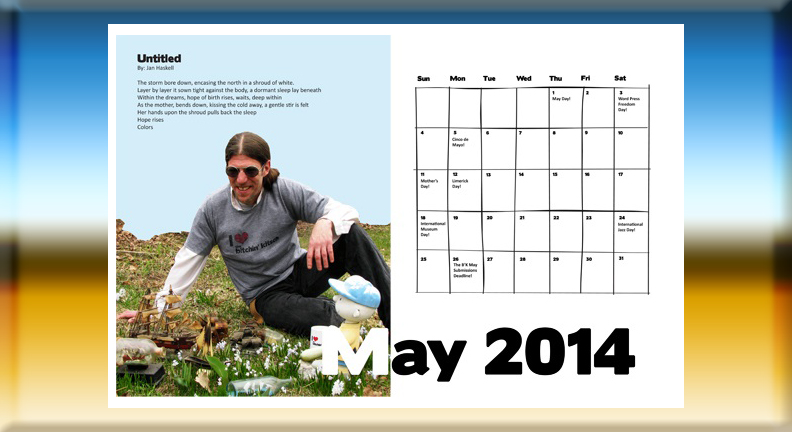
The Embarcadero” was published in the May 2014 issue, on page 16 of The Bitchin’ Kitsch. “The Embarcadero” isn’t exactly a break up story (though it’s enough of a break up story that an editor once informed me they prefer not to publish break up stories). Rather, it’s about a missed connection. I think most people have seen love thwarted by circumstances that would otherwise seem peripheral: the timing just wasn’t right. The story is also just a moment, and I will never stop being thrilled by the narrative potential of small and insignificant acts.

Editor Chris Talbot-Heindl bio:

is a queer, trans nonbinary, triracial (white, Japanese, and Indigenous) artist, educomics creator, and nonprofit laborer trying to build spaces ready to celebrate when they turn up authentically.

They have over two decades of experience working with environmental and LGBTIQA2+ nonprofits in every capacity from dedicated database volunteer, event assistant, office manager, volunteer manager, communications director, social media manager, database manager, membership and donation manager, curriculum developer and manual designer, Moodle administrator, branding and marketing creator, graphic designer, web designer, illustrator, and everything in-between. They pride themselves on being a Jesse-of-All-Trades, learning new skills as needed to accomplish what needs doing.

Chris has over four decades of experience living in a white-, cis-, het-, abled-supremacist society and 25 years’ worth of DEI training aimed at helping them navigate this world in their body. As such, they center and advocate for equity at the forefront of everything they do. If you aren’t ready to do the work with inclusion, equity, accessibility, and justice at the forefront, working with Chris won’t be a good fit. You have to be willing, ready, and excited to do this work.

When they aren’t consulting or working their day-job, Chris can be found editing the quarterly art and literature compzine, The Bitchin’ Kitsch, the biyearly themed art and literature compzine, All My Relations, and Community-Centric Fundraising’s Content Hub; making educomics like Chrissplains Nonbinary Advocacy to Cisgender People and Why Must the White Cis Nonprofit Workers Angry React to All My Posts?; working on their serial graphic novel The Story of Them about what it’s like to be nonbinary in a very gender-binar world; and writing essay and short stories exploring identity and belonging.

Leave a comment

Filed under Literature, Memoir, Short Story

Serving House Journal – “Those Lonely, Lonely Nights”

Serving House is defunct, but read the story online here.


“Those Lonely, Lonely Nights,” was published in Issue 9 of Serving House Journal. The story is about a conversation with a methamphetamine addict in a bar in Santa Cruz. If there’s a deep truth to be plucked from this story, it might have something to do with the ways that our hedonism blinds us. It might also be about a man willing to put himself halfway in danger, but never all the way.

The Serving House Journal was an amazing publication that unfortunately stopped publication in 2018. Not only did this publication showcase superb contemporary literature, they had an amazing editorial staff – Duff Brenna, Clare McQueen, and Thomas E. Kennedy to name a few.


Serving House mission statement:

Serving House Journal endeavors to publish works in the literary and visual arts that will surprise, rivet, amuse, charm, enchant — even electrify— our readers.

Our mission is to play an international role in fostering and preserving the best of what the literary arts are capable of doing: writing that may impel others to become writers themselves; writing that will add to and enhance the dialogue of the arts; writing that reaffirms our belief in the inspiring possibilities of the written word.

We celebrate the imaginative voice, the authentic attitude towards the status quo “world of letters.” We like lean-edgy-elegant writing that takes on the stupefying realities of our challenging times, our thorny relationships, the political chicanery that exhausts our patience, the contraries between men, women, children, and friends.

We’re looking for work that strives to eclipse clichés, stereotypes, and mass-market formulas gleaned from what has become more and more a “reality show,” a “sit-com,” a stultifying Wal-Mart of the mind. “Expect poison from standing water,” William Blake once told us. “The cistern contains; the fountain overflows.”

Inscribe the flow of the world as you see it. Send that world to us. We promise you a fair reading.

Leave a comment

Filed under Literature, Memoir, Short Story