Tag Archives: writing

The Summerset Review – “Souvenirs”

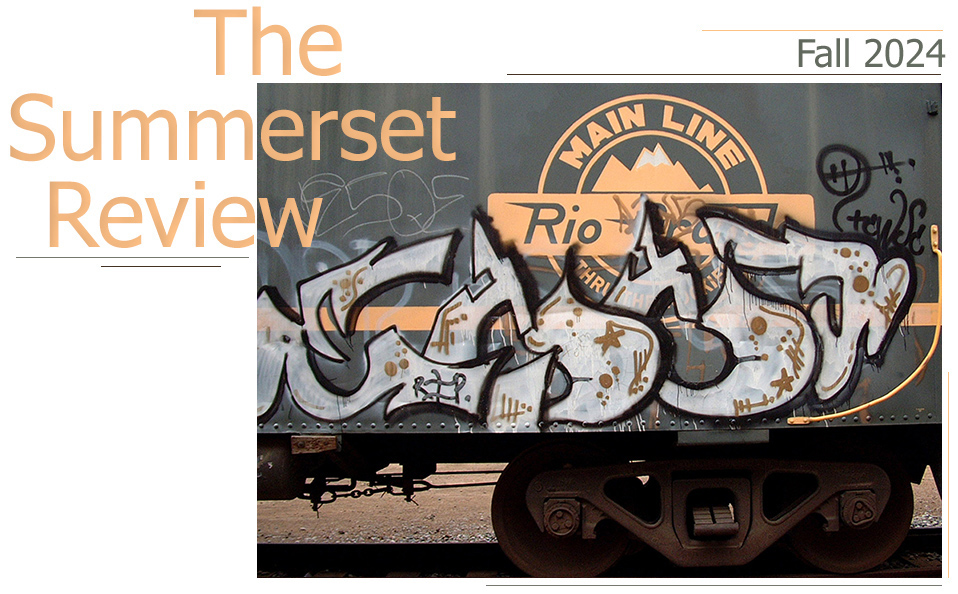
I’ve only recently resumed submitting stories for publication, and I am as proud as can be that my short story, “Souvenirs,” has been published in the Fall 2024 Issue of The Summerset Review. The story is about a cab ride not dissimilar to one I took nearly a decade ago, and I was struck by the story the cab driver told me. I spent years considering how I might tell the story, and this was what I came up with.

From the Summerset Review homepage:

The Summerset Review is a literary journal released quarterly on the 15th of March, June, September, and December on the Internet, and periodically in print form. Founded in 2002, the journal is exclusively devoted to the review and publication of unsolicited fiction, nonfiction, and poetry.

Staff Bios

Joseph Levens has had fiction and nonfiction appear in The Gettysburg Review, Florida Review (Editors’ Award for Fiction), New Orleans Review, AGNI, Sou’wester, Meridian, Other Voices, The Literary Review, Zone 3, The Good Men Project, and many other places. He lives on Long Island and currently teaches Creative Writing at Stony Brook University. www.josephlevens.com

Erin Murphy is the author or editor of eleven books, including Human Resources (forthcoming from Salmon Poetry of Ireland) and Assisted Living (Brick Road Poetry Prize, 2018), a collection of demi-sonnets, a form she devised. Her most recent co-edited anthology, Bodies of Truth: Personal Narratives on Illness, Disability, and Medicine (University of Nebraska Press, 2019), won the Foreword INDIES Gold Medal Book of the Year Award. Her awards include the Dorothy Sargent Rosenberg Poetry Prize, the Foley Poetry Award, the National Writers’ Union Poetry Award judged by Donald Hall, a Best of the Net award judged by Patricia Smith, and The Normal School Poetry Prize judged by Nick Flynn. She is Professor of English and Creative Writing at Penn State Altoona. www.erin-murphy.com

History of the Journal

The Summerset Review started as an online literary quarterly in 2002, publishing exclusively fiction and nonfiction. With a staff of three volunteers, the magazine faithfully produced its issues on time, reviewing unsolicited submissions year-round, the great majority of which were made electronically and sent through email from hopeful writers ranging from high school students to authors with many published books to their names.

Since 2002, the journal has taken on poetry, book reviews and art essays on occasion, and produced a few print issues collecting a sampling of work that previously appeared online. Remaining ad-free and accessible at zero cost to readers, the publication has released all quarterly issues on time over its twenty-year history. Editorial staff members are proud to say that they respond to all submissions within four months, do not solicit authors, and do not navigate a slush pile.

The Summerset Review has read at The New York Public Library, national conferences, colleges, and other places, including events sponsored by the Council of Literary Magazines and Presses (CLMP), the New York State Council on the Arts (NYSCA), the National Endowment for the Arts (NEA), the National Council of Teachers of English (NCTE), and the Association of Literary Scholars and Critics (ALSC). Print issues of the magazine are frequently donated to book fairs across the country, with all proceeds going to charitable causes in the respective areas.

Work originally published in The Summerset Review has been reprinted in the Pushcart Prize, the Best American series, the PEN America Award series, the Best of the Net anthology, notable collections such as the Iowa Short Fiction Award, and a great many books published by our contributors.

Mission Statement

We think of ourselves as simply people who like to read good contemporary literature, who want to share the best of our experiences with others. The highest form of retribution for our efforts is a lasting impact on a few sensitive readers of our journal—people we don’t know, people we will never meet. We received an email from a reader once, who said a story in our current issue (at the time) changed her life. Assuming this change was for the better, what more could we ask for?

Leave a comment

Filed under Literature, Memoir, Short Story

September 18, 2021 – Description of the Northern Lights

The first thing to mention, before the beauty of it and the effect of it, is that it felt like a rare privilege, something that most would not get to experience or see.

I first saw it when I was rinsing the mop bucket on the back deck. I’d been told the conditions in which the Northern Lights were most likely to appear – cold, clear nights. It’s obviously been getting colder and colder, but clear nights are surprisingly uncommon. They’re not unheard of, but the skies are most often overcast, and the phenomenon seems to occur above the clouds. So when I noticed that the stars were out, I began inspecting the skies. And sure enough, I spotted the first band of green vapors over the shores to the east of us. The bands are ribbon-like, curving across the sky, sometimes seeming to approach or fall further into the distance. The base is the most visible, vibrant part, meaning that it is illuminated most brightly and that light fades upwards from the horizon. I was surprised by how dynamic the northern lights were, like a ribbon moving in a breeze. They brighten and dim from one second to the next. And then, in the most intense moments, there is also a sort of vertical movement, as the light dances and shifts in strands that stand upright, reminiscent of the way that water shimmers. The spectacle might be similar to a thick mist, constantly shifting while illuminated from behind. That said, such a description doesn’t quite capture the effect, as the vapors seemed almost to be illuminated from within. At one point, I could see the vapors rippling from the horizon and passing directly overhead, swirling like a vortex above the boat and rising infinitely upward.

And the affect of this, which I tried to describe to you over the phone, was a kind of melancholy. There was a lugubriousnss to the movement of the light, a meandering, sort of lumbering march across the sky. The dynamism of movement meant that they could appear or disappear from one second to the next, but, when observed, the movement seemed slow. Coupled with that was the fact that the vapors seemed to slowly evaporate skyward in a constantly rising mist, the vertical light rising towards the heavens and vanishing. The green color was simultaneously vibrant and solemn, and seemed barely willing to announce its existence within the mist. And yet, the grandure and majesty of it gave it an eternal quality, as if those bands of light had been engaged in that march long before we arrived and would continue it long after we go. 

And of course, the context for this was a freezing night over the Alaskan tundra. I know that those lights are visible in other parts of the state, over other landscapes. But there, in the frozen tundra, over the freezing ocean, in a place that was so inhospitable that it nearly remained frontier but for the intrusion of humans digging away at the frozen land (a local man told me that Christian natives had to bury relatives using jackhammers to unearth the permafrost). It was a lonely place, barely inhabitable by humans, animals, and even plant life. And there’s also something sad about the landscape in that it was a sort of reminder of how much humans have intruded into and exploited the natural world, as if nature had been forced to retreat to this most remote locale, looking back with a sort of mournful melancholy. Completing the ambiance is the shriek of the un-greased belt of the shoreside hopper, which emits a sort of melodic whistle when in operation, a sound like a dozen apparitions whistling in harmony. And so the ghostly lights marching across the sky, already haunting in appearance, haunting in context, come to seem like the final departure of nature, forced to retreat skyward, to some other realm as the humans continue to encroach and intercede. And that is the best way I can describe the melancholy affect of the northern lights.

Leave a comment

Filed under Blog Posts, Literature, Memoir

August 23, 2021 – Meditations on the Buck that Visited Us Each Night

Written as a part of an email home while working on a tugboat in the Arctic Circle of Northern Alaska.

We had an adolescent buck that would visit our backyard each night, and we’d taken to feeding the animal. There were other animals that came though as well – skunks and cats and possums and squirrels and birds – so there were a million noises outside the open bedroom window, and each had to be investigated. But we were waiting for the buck. Each of the other animals was of interest, but the buck was the spectacle.

When he arrived, I cut up apples for him in the yard while he watched me, and left them in one of our barren planters. He was a handsome animal, with a perfectly black nose and muzzle. He watched me with his large black eyes while I prepared his food and I imagined I saw something like sadness there: not out of concern for me – my presence or absence – but because he was no longer a master of the wild there. He was a refugee, creeping through the night.

I was amazed that the old neighbors didn’t like the bucks. If one were able to say that the animals ruined the gardening, or were dangerous, or that there was anything threatening about them at all, then I would have accepted it. But they just didn’t like critters. In contrast, the deer were one of my favorite things – majestic and kind of mysterious. They reminded me Joseph Campbell’s writing. Campbell described a prehistoric time, kind of an origin of myth, before humankind took for granted that they were the ruling species on the planet: 

“In those earliest millenniums… men dwelt and moved about in little groups as a minority on this earth. Today we are the great majority, and the enemies that we face are of our own species. Then, on the other hand, the great majority were the beasts, who, furthermore, were the “old-timers” on earth, fixed and certain in their ways, at home here, and many of them extremely dangerous.”

It’s sad, I think, but the bucks are a vestige of that time. They’re kind of vagabonds, in hiding. They’re furtive, not owners of the world that was once theirs entirely, theirs to exist in utter deer-ness. But now they stalked through the night, strangers in an inhospitable world. Perhaps (I hope) our yard provides a tiny little haven for creatures beleaguered by humankind.

Leave a comment

December 14, 2023 · 12:20 pm